How to start a coworking space in India

The short answer
Starting a coworking space in India comes down to ten decisions, in this order: the business model, the micro-market, the building, the terms with the landlord, the floor plan and fit-out, your products and prices, GST registration, the team, your systems, and selling seats before you open. The money question is two numbers: the occupancy at which the centre covers its monthly costs, and the month the upfront cash comes back. In the illustrative example below, a 10,000 sq ft, 200-seat centre needs about ₹2.19 crore upfront including a refundable deposit, breaks even at 51% occupancy and pays back in month 42. The setup cost calculator linked below works this out for your own numbers.
Who this guide is for
This guide is for founders, real estate owners and operators planning a coworking or managed office centre in India: a first centre, a second one, or a building you own and want to run as flexible workspace. It covers the decisions in the order you will meet them, what each one costs, and how to tell whether the centre will make money.
It is a practical guide, not legal or tax advice. Leases, licences, approvals and GST depend on your state, your building and your structure. Check them with a lawyer and a Chartered Accountant before you sign.
Choose a business model
There are four common ways to run a coworking centre. Most operators start with one and add others later.
| Model | How it works | Works well when | Watch out for |
|---|---|---|---|
| Lease and operate | You lease the space, pay for the fit-out and keep all the revenue | You can fund the fit-out and want full control | You carry the rent whether seats are full or not |
| Managed or revenue share | The landlord pays for some or all of the fit-out; you run the centre and share revenue or profit | Landlords with empty floors want a partner rather than a single tenant | Less upside, and the agreement decides who controls pricing and staff |
| Franchise | You run a centre under an established brand and pay fees or a revenue share | You want a known brand and a playbook | Fees, brand rules and limits on where else you can operate |
| Managed office for enterprises | You fit out and run a dedicated floor for one company on a multi-year agreement | You have, or can win, enterprise clients | Long agreements, client-specific fit-out, and concentration on one client |
Many centres mix these: open coworking floors for startups and smaller teams, plus one or two floors run as managed offices for enterprises.
Step 1: pick the micro-market
Demand for flexible workspace is local. Two buildings a kilometre apart can fill at very different speeds.
- Who works nearby. Look at the companies within a short commute: startups, IT and services firms, consultants, and enterprises with satellite teams.
- Access. Metro and bus links, main roads and parking matter more than the view.
- Supply. Visit every centre within a few kilometres. Note their prices, how full they look on a weekday, what they include and who their clients are.
- Price ceiling. What do companies nearby pay for conventional office space? Your price per seat has to make sense against that.
- Your edge. Decide what you offer that nearby centres don't: price, managed offices, a community for a particular industry, or better service.
Step 2: choose the building
The building decides your costs for years. Check:
- Floor plate. A regular, open floor fits more seats and makes cabins and meeting rooms easier to plan.
- Power backup. DG sets and UPS capacity for full occupancy, and how power is metered and charged.
- Air conditioning. Central or split, who maintains it, and the hours it runs.
- Lifts, washrooms and fire exits for the number of people you plan to seat.
- Parking for members and visitors, and what it costs.
- Approvals. The building's occupancy certificate, fire NOC and permitted commercial use. Ask a lawyer to check the title and the approvals before you commit.
- Internet. At least two providers able to bring fibre into the building.
Step 3: agree terms with the landlord
Whether it is a lease, a leave and licence agreement or a revenue-share agreement, the terms that matter most to a coworking business are:
- Rent-free period for the fit-out, and when rent starts.
- Lock-in for you, and how it compares with the lock-ins you will offer your members.
- Escalation of rent and maintenance, and how often.
- Security deposit, usually a number of months of rent, and when it is refunded.
- Permission to sub-license the space to members and to put up your brand.
- Who pays for what: maintenance, power, property tax, insurance and repairs.
- Exit terms and the condition you must return the space in.
Stamp duty and registration depend on the state and the type of agreement. A local property lawyer should draft or review it.
Step 4: plan the floor and the fit-out
- Seat count. Decide the mix of open desks, private cabins, managed office areas, meeting rooms, phone booths, a pantry and a reception. Each changes how many seats you can sell from the same area.
- Space per seat. Work out the area per sellable seat from your plan, and use it in your numbers. Generous layouts sell at higher prices; dense layouts sell more seats.
- Fit-out scope. Interiors, electrical, air conditioning changes, data cabling, access cards, CCTV, signage and branding.
- Furniture and IT. Desks, chairs, storage, meeting room screens, Wi-Fi, firewall and printers.
- Quotes. Get at least two or three detailed quotes per sq ft and per seat, and allow a contingency for surprises.
- Time. Agree the fit-out timeline with the contractor and match it to the rent-free period.
Step 5: set your products and prices
Most centres sell a mix of:
- Dedicated desks and flexible (hot) desks, priced per seat per month.
- Private cabins for small teams, priced per seat or per cabin.
- Managed offices: a floor or wing for one company, often with custom fit-out and a longer agreement.
- Meeting rooms and event space, by the hour, with a monthly allowance included for members.
- Virtual office services: a business address and mail handling for companies that don't need a desk.
- Add-ons: parking, storage, printing and additional meeting room hours.
Set a list price for each product, decide who can approve a discount and how much, and write down your standard lock-in, notice period, escalation and deposit. Consistent terms make billing and renewals much easier later. The seat price calculator shows what a deal is worth over its term, including escalations and the first GST invoice.
Step 6: GST registration and invoicing
Most coworking clients are businesses that will claim input tax credit, so they will expect a correct GST tax invoice from your first month.
- Register for GST in each state where you have a centre. Each state registration has its own GSTIN.
- Coworking and managed office fees are generally billed under SAC 997212 at 18%. Whether you charge CGST and SGST or IGST depends on the place of supply.
- Invoices must carry the details required under CGST Rule 46, and seat changes are handled with credit and debit notes.
- TDS. Clients may deduct TDS from what they pay you, so receipts arrive net. Track it so you can match it with Form 26AS.
The details are in our guides on GST on coworking and managed offices, TDS on coworking fees and the GST invoice format. Confirm your own position with a Chartered Accountant.
Step 7: build the team
A single centre usually needs:
- A centre or community manager who owns the member experience, the front desk and the daily routine.
- Front desk and facilities support for visitors, parcels, meeting rooms, housekeeping and maintenance vendors.
- Sales, at least one person or the founder, for enquiries, site visits and renewals.
- Finance and billing, often part-time at first, for invoices, collections and GST.
As you add centres, standards matter more than headcount. See how to manage multiple coworking centres and the community manager daily checklist.
Step 8: put the systems in place
Before the first member arrives, decide how you will handle:
- Member requests and bookings: meeting rooms, guests, service requests and announcements.
- Visitors and the front desk: who is expected, who is in the building, and who signs for parcels.
- Sales: enquiries, site visits, quotes and which seats are actually free.
- Agreements and billing: agreements with escalations, monthly GST invoices, credit notes, payments and TDS.
- Reporting: occupancy, revenue and dues for the centre.
Many new centres start with spreadsheets and messaging groups and move to software when the second centre or the first enterprise client arrives. Moving later means migrating data and habits. Whichever way you go, use one source of truth for which seats are sold and what each client pays. Our guide on how to choose coworking management software lists what to evaluate.
Step 9: sell before you open
- Start selling as soon as the floor plan is final, with renders and a mock-up of a cabin if you can.
- List your centre with brokers and online platforms that send enquiries from companies looking for space.
- Talk to companies nearby directly, especially teams that are outgrowing their current office.
- Offer founding-member terms that are generous but time-bound, and approved like any other discount.
- Track every enquiry from first contact to signed agreement, so you know which channels fill seats.
Step 10: open and fill up
- Run a soft launch with your first members before the public opening to find the problems.
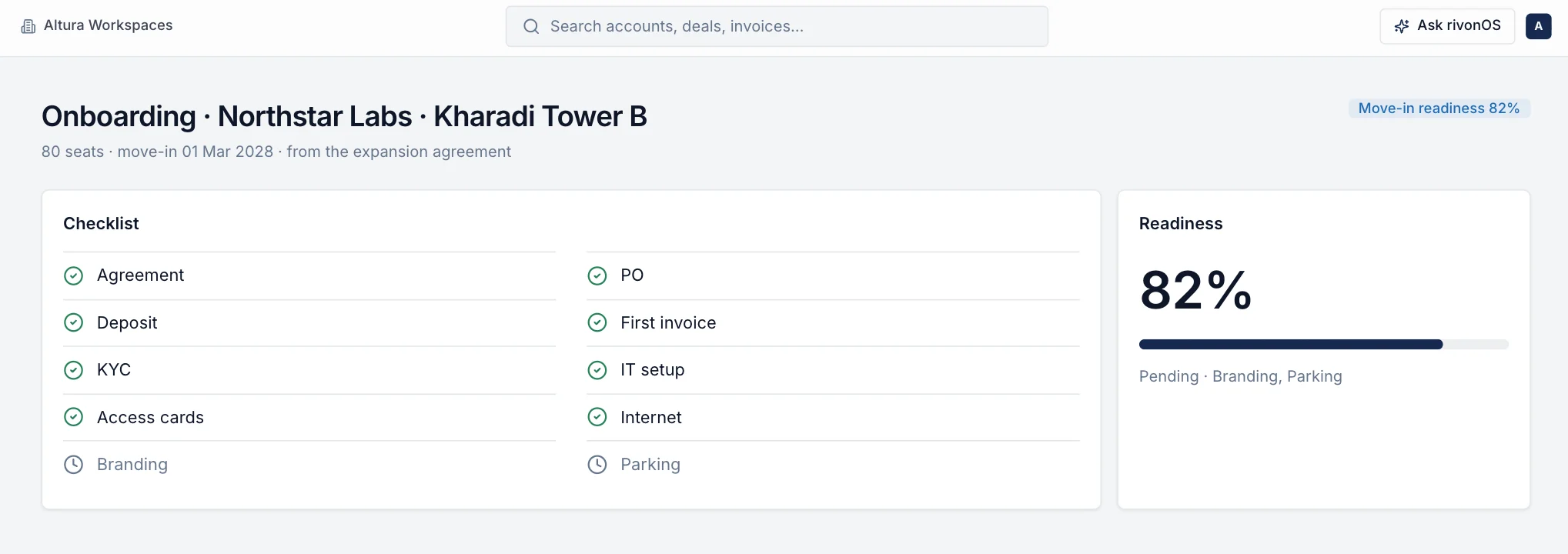
- Do a move-in checklist for every new client: agreement, deposit, KYC, purchase order, access cards, Wi-Fi and parking. See the member onboarding checklist.
- Review weekly while the centre fills: enquiries, site visits, deals, occupancy and collections.
- Plan the cash for the fill-up period. A new centre pays full rent and running costs before it has enough members to cover them.
What it costs: a worked example
This example is illustrative. The numbers are chosen to show the method, not to describe a typical centre in any Indian city. Replace them with your own quotes.
A centre leases 10,000 sq ft and plans 200 sellable seats.
| Upfront, one time | Calculation | Amount |
|---|---|---|
| Fit-out | 10,000 sq ft × ₹1,500 | ₹1,50,00,000 |
| Furniture and IT | 200 seats × ₹15,000 | ₹30,00,000 |
| Security deposit (refundable) | 6 months × ₹6,50,000 rent | ₹39,00,000 |
| Total upfront cash | ₹2,19,00,000 |
| Every month | Calculation | Amount |
|---|---|---|
| Rent | 10,000 sq ft × ₹65 | ₹6,50,000 |
| Common area maintenance | 10,000 sq ft × ₹12 | ₹1,20,000 |
| Team, power, internet, housekeeping, software | ₹3,00,000 | |
| Fixed costs | ₹10,70,000 |
Members pay a realised ₹12,000 per seat a month, and each occupied seat adds ₹1,500 of variable cost, so each paying seat contributes ₹10,500 towards fixed costs.
- Break-even seats = ₹10,70,000 ÷ ₹10,500 = 101.9, so 102 seats, or 51% occupancy.
- Once the centre is stable at 85% (170 seats): 170 × ₹10,500 − ₹10,70,000 = ₹7,15,000 operating contribution a month.
- If the centre opens at 25% and fills evenly to 85% by month 12, it loses money for the first five months, and the upfront cash comes back in month 42 including the deposit, or month 36 without it.
Is coworking profitable?
A coworking centre can be a good business, but only if three things hold together:
- Stable occupancy well above break-even. If break-even is 75% and the centre runs at 80%, one client leaving puts it back into loss. Read coworking break-even occupancy for the formula and what moves it.
- Realised price, not list price. Discounts, rent-free months and free extras lower revenue per seat and raise break-even. See where flex revenue leaks.
- A plan to recover the fit-out. Covering monthly costs is not the same as earning back the money spent to build the centre, and the operating contribution above leaves out depreciation, interest, tax and head-office costs.
Track occupancy, realised price and collections every month from the first month. The occupancy and seat yield calculator and the break-even calculator help you keep an eye on them.
Thinking about a franchise
A franchise can shorten the learning curve, but read the agreement as carefully as the lease. Ask:
- Fees: the upfront fee, the ongoing royalty or revenue share, and any marketing or technology fees.
- What you get: brand, design standards, sales leads, training, software and purchasing terms.
- Control: who sets prices and discounts, who signs client agreements, and who owns the client relationship.
- Territory: whether you have exclusivity in your area, and what stops the brand from opening nearby.
- Exit: how long the agreement runs, how you can leave, and what happens to the fit-out and clients if you do.
Speak to two or three existing franchisees before signing, and run the setup cost calculator with the franchise fees added to your fixed costs.
Mistakes to avoid
- Signing the lease before the numbers work. Run the setup cost and break-even numbers with real quotes first.
- Underestimating the fill-up period. Plan for several months of losses and keep cash for them.
- Planning more seats than the building supports. Power backup, air conditioning, washrooms and lifts all limit how many people the floor can hold.
- Discounting to fill the first floor. Early deep discounts become the price everyone expects at renewal.
- Inconsistent agreements. Different lock-ins, notice periods and escalations for every client make billing and renewals hard to manage.
- Leaving GST until the first invoice. Register, set up your invoice format and confirm the tax treatment before the first client signs.
Questions operators ask
How much does it cost to start a coworking space in India?
It depends mostly on the area, the standard of fit-out, rent in that micro-market, the deposit and how many seats you plan. In the illustrative example above, a 10,000 sq ft centre needs about ₹2.19 crore upfront including a ₹39 lakh refundable deposit. Get quotes for your own space and use the setup cost calculator.
How long does a coworking space take to break even?
Break-even each month depends on occupancy: the centre covers its monthly costs once enough seats are paying. Earning back the upfront cash takes longer, and depends on how fast the centre fills and how far stable occupancy sits above break-even. Model both before you sign the lease.
Do I need a GST registration to run a coworking space?
Most operators register from the start because their clients are businesses that need GST invoices to claim input tax credit, and registration is required once turnover crosses the threshold. Confirm with a Chartered Accountant, and see GST on coworking and managed offices.
Should I start with coworking or managed offices?
Coworking floors fill with many smaller clients and spread the risk. Managed offices bring larger, longer agreements but depend on a few clients. Many centres start with coworking and add managed office floors once they have enterprise demand.
When should a new centre start using coworking management software?
Ideally before the first member moves in, so bookings, visitors, agreements and invoices start in one place rather than being moved later. Our guide on how to choose coworking management software covers what to look for. To see rivonOS on your plans for a new centre, book a walkthrough.