TDS on coworking and managed office fees: a guide for operators
The short answer
Most company clients treat a coworking or managed office fee as rent for the use of a building, furniture and fittings and deduct 10% once the payment is more than ₹50,000 for a month. Under the old Act this was section 194-I; from 1 April 2026 it is section 393(1) of the Income-tax Act, 2025, Table serial 2(ii). Some clients deduct under the fees-for-services provisions instead; the right answer depends on the arrangement. TDS is deducted on the fee without the GST when the GST is shown separately. Record every deduction against the invoice and check it appears in your Form 26AS.
Why TDS matters to an operator
When an enterprise client pays your invoice, it usually keeps back part of the fee as tax deducted at source (TDS) and pays it to the government against your PAN. That money is your income tax paid in advance. You get the credit only if the client deposits it, files its TDS statement correctly and the amount shows up in your annual tax statement (Form 26AS). If any step goes wrong, the cash is gone from the invoice and the credit is missing from your return.
For an operator with a few hundred enterprise seats, TDS runs into lakhs every month. It deserves the same care as the invoice itself. This guide is written for operators, the people receiving the payment, not for the clients deducting it.
This guide was reviewed by Riya Maheshwari and Pratik Agrawal, Chartered Accountants and co-founders of rivonOS, on 7 October 2026. It explains the rules as they stood on that date and is not tax advice for your situation.
Rent or fees for services: why the advice conflicts
Search for "TDS on coworking" and you will find three answers: rent at 10%, fees for technical services at 2%, and fees for professional services at 10%. They cannot all be right for the same arrangement. The question is what the client is really paying for.
The case for rent. Under the 1961 Act, "rent" meant any payment "under any lease, sub-lease, tenancy or any other agreement or arrangement for the use of (either separately or together)" land, a building, plant, machinery, equipment, furniture or fittings, whether or not the payee owns them (Explanation to section 194-I). A licence to use seats, cabins or a floor in a serviced centre is an arrangement for the use of a building with furniture and fittings, even though the operator is not the owner and even though services come with it. Most practitioners take this view for managed offices and dedicated seats.
A useful comparison: hotel rooms. The CBDT has said that hotel rooms taken on a "regular basis" are covered by the rent provisions, and that rooms are on a regular basis where specific rooms are earmarked for a set rate and period, or where the hotel is legally bound to provide rooms for the term of the agreement. A simple rate contract with no such obligation is "occasional or casual" use (Circular 715 of 8 August 1995, question 20, and Circular 5/2002 of 30 July 2002). The same test is a reasonable way to think about flex workspace.
The case for fees for services. Some clients see a coworking membership as a bundle of business support services and deduct under the fees for technical or professional services provisions (section 194J under the old Act). The weakness of this view is that those provisions are about managerial, technical, consultancy or professional services. Providing furnished space with internet and housekeeping is mainly the use of a building. Tribunals have also held that routine services without that human expertise, such as maintenance, are not "technical services".
Separately billed services. Where common area maintenance or other services are billed separately from the space, some tribunal rulings have treated them as payments for work under section 194C rather than as rent. One example is the Delhi bench of the Income Tax Appellate Tribunal in the case of Liberty Retail Revolutions Limited on common area maintenance charges.
How the factors usually point:
| Arrangement | What the client gets | How it is usually treated | Why |
|---|---|---|---|
| Managed office or private cabin, fixed term, lock-in | Exclusive use of identified space, furnished | Rent, building and furniture | Arrangement for the use of a building, furniture and fittings |
| Dedicated desks on a monthly or longer agreement | An assigned seat for the term | Rent, building and furniture | Specific space earmarked for a set period |
| Hot desks, day passes, meeting rooms booked now and then | A right to use whatever is free | Arguable either way | Closer to occasional use under a rate contract |
| Services billed separately (maintenance, IT support, events) | Services, not space | Often work (194C) or services, depending on the service | Not a payment for the use of space |
What to do as an operator. You do not decide the section; your client does, and the client carries the risk of deducting too little. But you can make their decision easy and consistent: describe the arrangement clearly on the agreement and invoice ("licence to use 240 workstations at Kharadi, Pune, with services"), keep add-on services on separate lines, and tell your client in writing which section your other enterprise clients use. Consistency across clients makes your reconciliation far simpler.
Rates and thresholds, old and new section numbers
The Income-tax Act, 2025 replaced the Income-tax Act, 1961 from 1 April 2026. TDS provisions that sat in separate sections (194-I, 194J and others) now sit in one table in section 393(1), identified by serial number. Amounts paid or credited up to 31 March 2026 follow the old Act.
| Payment | Old Act (1961) | Income-tax Act, 2025 | Rate | Threshold |
|---|---|---|---|---|
| Rent for land, building, furniture or fittings, paid by a specified person | Section 194-I(b) | Section 393(1), Table serial 2(ii)(b) | 10% | More than ₹50,000 for a month or part of a month |
| Rent for plant, machinery or equipment, paid by a specified person | Section 194-I(a) | Section 393(1), Table serial 2(ii)(a) | 2% | More than ₹50,000 for a month or part of a month |
| Rent paid by a person who is not a specified person (for example a small individual business) | Section 194-IB | Section 393(1), Table serial 2(i) | 2% | More than ₹50,000 for a month or part of a month |
| Fees for technical services | Section 194J | Section 393(1), Table serial 6(iii)(a) | 2% | ₹50,000 |
| Fees for professional services | Section 194J | Section 393(1), Table serial 6(iii)(b) | 10% | ₹50,000 |
| Payments for work (contracts) | Section 194C | Section 393(1), contractor payments entry | 1% or 2% | Per contract and yearly limits, as set out in the Act |
A specified person, for the rent entries, is any person other than an individual or Hindu undivided family, and also an individual or HUF whose business turnover was above ₹1 crore (or professional receipts above ₹50 lakh) in the previous year. Almost every enterprise client is a specified person, so 10% is the rate you will see most.
Under the old Act, the rent threshold was ₹2,40,000 a year until 31 March 2025 and ₹50,000 for a month or part of a month from 1 April 2025; the section 194J threshold rose from ₹30,000 to ₹50,000 on the same date. Many web pages still show the old figures.
No TDS on the GST shown separately
CBDT Circular 23/2017 (19 July 2017) says that where, under the agreement between payer and payee, the GST on services is "indicated separately", tax is to be deducted at source on the amount "without including such GST on services". It replaced the same rule for service tax in Circular 1/2014.
Two things follow for operators:
- Show GST separately on every invoice. A GST tax invoice under CGST Rule 46 does this anyway. If a client deducts 10% on the GST-inclusive total, it has deducted 18% more TDS than it needed to, and that cash is held up until you claim it back in your return.
- Check the TDS on each receipt. On a ₹26,16,000 fee with ₹4,70,880 GST, the right TDS at 10% is ₹2,61,600. If you receive ₹27,78,192, the client deducted ₹3,08,688, on the total. Raise it the same week, before the quarter's TDS statement is filed.
Deposits, lock-in charges and year-end provisions
- Refundable security deposit. A deposit you must return is not rent, so clients do not usually deduct TDS on it. If part is later kept as rent or a charge, TDS may apply at that point.
- Lock-in and notice-period charges. These are paid for the arrangement for use of the space, so clients usually treat them as rent.
- Timing. TDS is due when the amount is credited to your account in the client's books or when it is paid, whichever is earlier. A client that books a provision for your March invoice in its year-end accounts may deduct TDS in March even if it pays in April. That deduction appears in the March quarter of your Form 26AS, not the June quarter.
Lower deduction certificates
If TDS at 10% of your revenue is more than your likely tax for the year (common for a growing operator with high lease and fit-out costs), you can apply to the Assessing Officer for a certificate that lets clients deduct at a lower rate. Under the old Act this was section 197 with Form 13; the Income-tax Act, 2025 keeps this facility, and the application is made online on the income-tax portal. Send each client a copy of the certificate, and check its validity dates and the limit it sets for each client.
Certificates and reconciliation with Form 26AS
Your client deposits the TDS, files a quarterly TDS statement and gives you a TDS certificate. Under the old rules these were Form 26Q and Form 16A. From the 2026-27 tax year, the TDS certificate for payments other than salary is Form 131 and the annual tax statement that was Form 26AS is Form 168.
A simple monthly routine catches nearly every problem:
- For each receipt, record the TDS amount next to the invoice it relates to.
- Each quarter, download your annual tax statement and the Annual Information Statement (AIS) from the income tax portal.
- Match by the client's TAN, quarter and amount. Total TDS you recorded for each client should equal what the statement shows for that TAN.
- Chase every difference. The usual causes are: the client used a wrong PAN, the client deducted but has not yet filed the statement, the TDS sits in a different quarter because of a year-end provision, the client deducted on the GST, or the deduction was shown under a different section.
- Ask for a correction statement where needed. Collect the TDS certificates and keep them with the invoices.
TDS that never shows up in your statement is effectively a short payment. Treat it as an open balance on the client's account until it does.
Worked example: a year of TDS for Northstar Labs
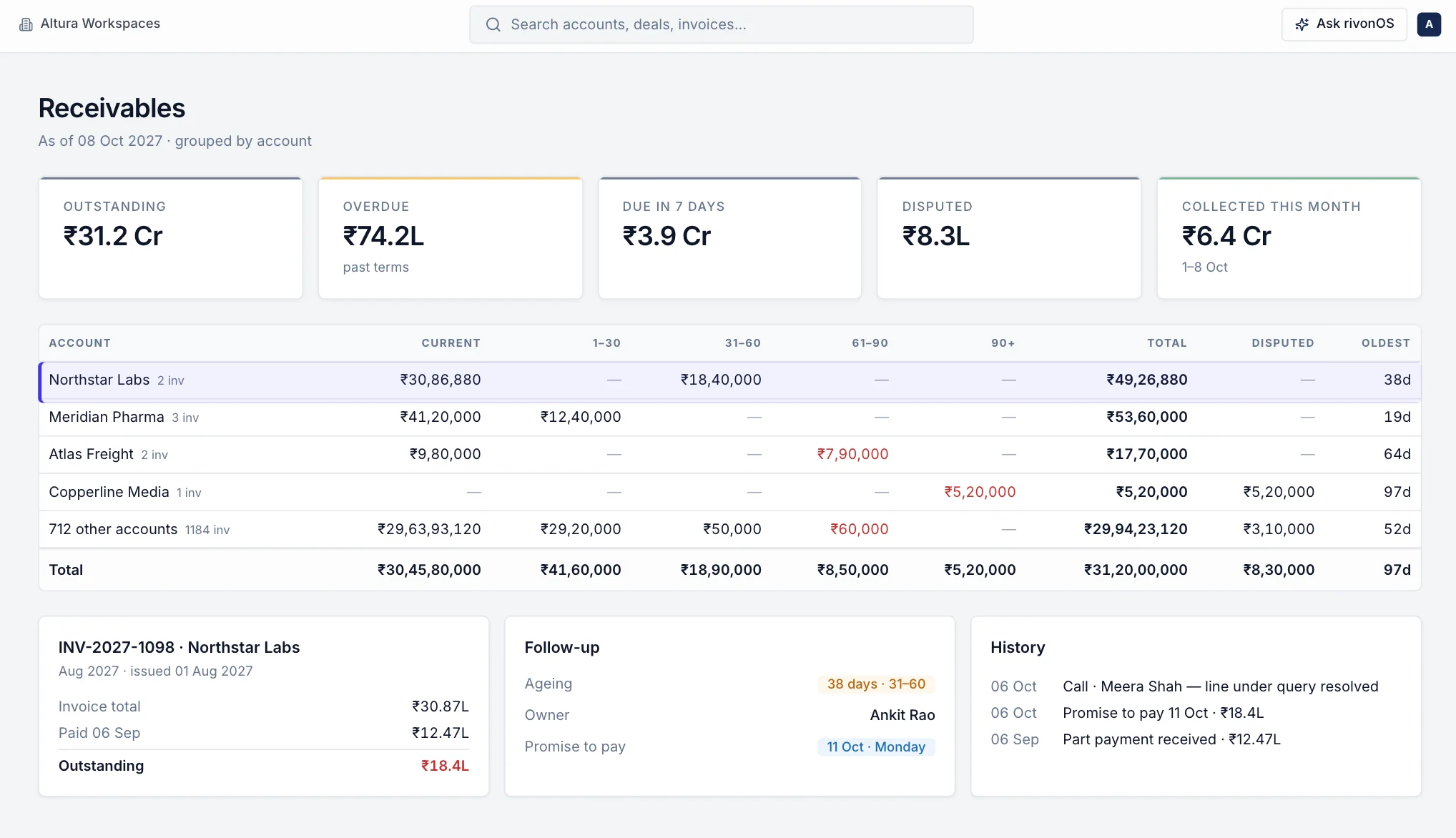
Northstar Labs, a company, licenses 240 seats at ₹10,900 per seat a month at Altura's Kharadi centre in Pune. It treats the fee as rent for a building with furniture and fittings: 10% under section 393(1), Table serial 2(ii)(b).
| Each month | A year (12 months) | |
|---|---|---|
| Licence fee (taxable value) | ₹26,16,000 | ₹3,13,92,000 |
| GST at 18% | ₹4,70,880 | ₹56,50,560 |
| Invoice total | ₹30,86,880 | ₹3,70,42,560 |
| TDS at 10% of the fee, not the GST | ₹2,61,600 | ₹31,39,200 |
| Paid to Altura by bank transfer | ₹28,25,280 | ₹3,39,03,360 |
₹31.39 lakh a year of Altura's tax credit depends on one client's TDS filings. Across a portfolio, it is a large number to leave unreconciled.
Illustrative data: Altura Workspaces and Northstar Labs are fictional. Screens are faithful renderings of rivonOS.
How rivonOS handles TDS today
See billing and collections for how receipts work in the product.
Questions operators ask
Which section applies to TDS on a coworking fee?
Most company clients treat a managed office or dedicated seat licence as rent for the use of a building with furniture and fittings: 10% under section 393(1), Table serial 2(ii)(b) of the Income-tax Act, 2025 (section 194-I under the old Act). Occasional use and separately billed services can be treated differently.
What is the TDS threshold for rent?
More than ₹50,000 for a month or part of a month, under both the old Act (from 1 April 2025) and the Income-tax Act, 2025.
Should TDS be deducted on GST?
No, if the GST is shown separately on the invoice or agreement (CBDT Circular 23/2017).
Is TDS deducted on a security deposit?
Usually not on a refundable deposit. It may apply when part of the deposit is kept as rent or a charge.
What if the TDS does not appear in Form 26AS?
Ask the client to check the PAN, the quarter and whether its TDS statement has been filed, and to file a correction if needed. Until it appears, treat it as unpaid.
Sources
Checked on 7 October 2026. Some primary pages on incometaxindia.gov.in could not be fetched directly when this draft was written; where we relied on a copy of the text hosted elsewhere, it says so.
- Income-tax Act, 2025, section 393 on the Income Tax Department website, and the text of the section 393(1) Table as published by Indian Kanoon (serial 2 for rent, serial 6 for fees for professional and technical services).
- Income Tax Department, FAQs on TDS on rent.
- CBDT Circular 23/2017, 19 July 2017 (no TDS on GST shown separately), copy hosted by ITATonline.
- CBDT Circular 715, 8 August 1995 (question 20) and Circular 5/2002, 30 July 2002, on hotel rooms taken on a regular basis.
- Income Tax Department, Form 168 (earlier Form 26AS) and Form 16 and Form 16A.
- Income Tax Appellate Tribunal, Delhi, on common area maintenance charges under section 194C, as reported by Taxscan.
Changes to this guide: first draft, 7 October 2026.