Where flex revenue leaks: twelve points to check

The short answer
In enterprise flex, revenue is rarely lost in one big decision. It leaks in small gaps between teams: a discount nobody approved, an escalation that never reached the invoice, a PO that expired, TDS that was never matched, a lock-in charge waived over a phone call. Each leak below has a rupee example, a way to spot it with or without software, and the control that closes it. Ten of the twelve have a live control in rivonOS today, one is only partly covered (matching TDS), and one is not covered at all (usage-based add-ons).
The twelve leaks at a glance
Revenue leakage is money you were entitled to under an approved price or a signed agreement, but did not bill, did not collect, or gave away without anyone deciding to. It is different from a bad deal. A low price that the CFO approved is a decision; the same price given by a salesperson on WhatsApp is a leak.
How the examples work. Most examples use Northstar Labs, a fictional client of the fictional operator Altura Workspaces: 240 seats at the Kharadi centre in Pune, ₹10,900 per seat a month, 36 months from January 2027, 8% escalation each year, a 24-month lock-in and a 3-month deposit. Where an example needs another assumption, it says so. All amounts are before GST unless stated.
Illustrative data: Altura Workspaces and Northstar Labs are fictional. Screens are faithful renderings of rivonOS.
1. Discounts without an owner
How it happens. A salesperson needs to close before the quarter ends and agrees ₹11,800 instead of the target ₹12,400 on a call. Nobody with authority sees it until the agreement is drafted, by which time the client has the number in writing.
What it costs. ₹600 a seat on a 120-seat deal is ₹72,000 a month, ₹8.64 lakh a year, and ₹25.92 lakh over a 36-month term. Across a sales team, the same habit repeats every month.
How to spot it. Without software: every month, list each signed deal's price per seat against the price book's target for that centre, and ask who approved each gap. With software: compare realised price per seat with the target by centre, and list every quote below target with its approver.
The control. A written discount authority (for example up to 5% for a sales manager, up to 10% for a regional head, above that the CFO), a floor price nobody can go below without the top approver, and a rule that nobody approves their own discount.
In rivonOS. Quotes below target are routed by discount level. Each step has a time limit, and approvers are reminded when it passes. A person cannot approve their own request. The floor price is visible only to the roles allowed to see it. See pricing and approvals.
2. Concessions nobody counts
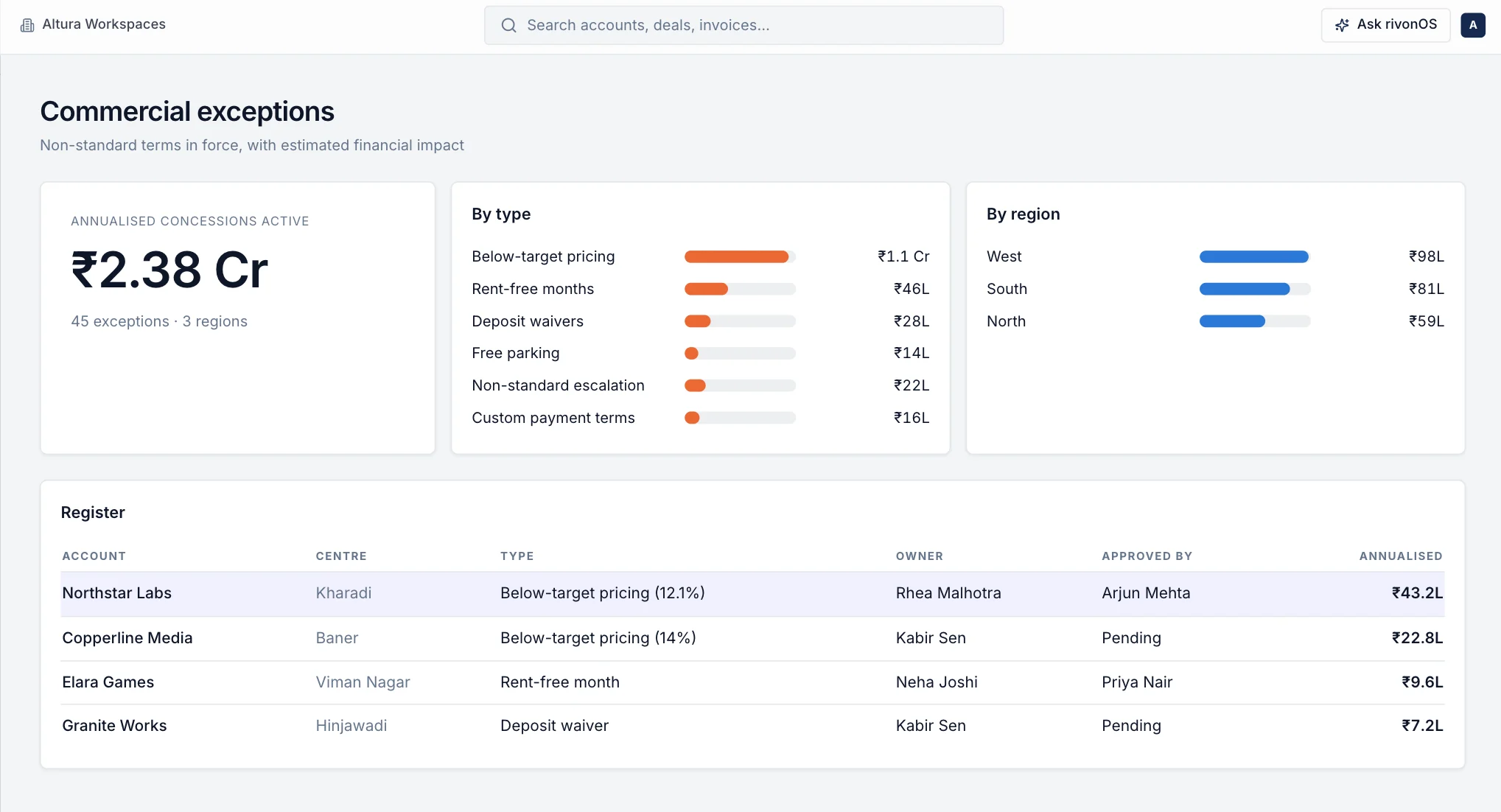
How it happens. The price holds, but the deal comes with one rent-free month, free parking, a reduced deposit or a softer escalation. Each looks small and is agreed separately, often after the price was approved. Nobody adds them up.
What it costs. One rent-free month on Northstar's 240 seats is ₹26.16 lakh, more than 8% of the first year's licence fees. Waiving one month of a three-month deposit leaves ₹26.16 lakh less cover if the client leaves early.
How to spot it. Without software: read the last 20 signed agreements and list every term that differs from your standard (free months, free parking, deposit, escalation, payment terms) with its value in rupees. With software: keep a register of every exception, valued and approved.
The control. Treat every concession as a priced exception that needs the same approval as a discount, and report the annual value of all exceptions to leadership every month.
In rivonOS. Rent-free periods, free parking, deposit waivers, waived escalation, custom payment terms, special services, custom clauses and below-floor or excessive discounts are recorded as exceptions on the quote with a rupee value, and need approval. See pricing and approvals.
3. The agreement drifts from the quote
How it happens. The quote was approved at 8% annual escalation. The agreement is drafted from an old template, or the client's legal team negotiates the clause down to 5%, and nobody compares the signed version with the approved quote.
What it costs. For Northstar, 5% instead of 8% means ₹11,445 instead of ₹11,772 per seat in year 2, and ₹12,017 instead of ₹12,714 in year 3. That is ₹9.42 lakh in year 2 and ₹20.07 lakh in year 3: ₹29.49 lakh over the term, on one clause.
How to spot it. Without software: before signing, check seats, monthly value, deposit, lock-in, notice, escalation and tenure in the agreement against the approved quote, field by field. With software: flag every difference automatically.
The control. The agreement is generated from the approved quote, and any adverse difference goes back for approval before signing.
In rivonOS. Agreements are created from the accepted quote. Differences in monthly value, deposit, lock-in, escalation, notice, tenure, seats and special terms are flagged, and adverse ones must be acknowledged by an approver and are then recorded as exceptions. See agreements and renewals.
4. Escalations that never reach the invoice
How it happens. The escalation is in the agreement, but billing runs from a spreadsheet that still has last year's rate. The client's accounts team does not mention it.
What it costs. Northstar's first escalation takes the rate from ₹10,900 to ₹11,772 in January 2028. Missing it for three months costs ₹6.28 lakh, and recovering it later means a debit note that the client's PO may not cover.
How to spot it. Without software: keep a list of every agreement's next escalation date and check it against the invoice run each month. With software: invoices built from the agreement's billing schedule, with escalation as a line.
The control. Bill from the agreement, not from a copy of it.
In rivonOS. When an agreement is activated, rivonOS builds its billing schedule, including each escalation, and each invoice shows the escalation as its own line. See billing and collections.
5. Seat changes and expansions billed late
How it happens. A client adds 80 seats from the 1st of the month. The amendment is signed, the seats are handed over, but billing hears about it from the client's next PO a month later.
What it costs. Northstar's expansion of 80 seats at ₹11,450 is ₹9.16 lakh a month. One month late is ₹9.16 lakh of cash a month later, and often a debate about whether the first month is billable at all.
How to spot it. Without software: reconcile seats occupied (from the centre) with seats billed (from finance), centre by centre, every month. With software: amendments that change the billing schedule as soon as they are approved.
The control. Seat changes go through a signed amendment, and the amendment, not an email, changes what is billed.
In rivonOS. Amendments to an agreement rebuild its billing schedule from the effective date, and a termination stops it. See agreements and renewals.
6. Usage add-ons nobody bills
How it happens. Meeting rooms beyond the included hours, printing, event space, after-hours air-conditioning and extra parking are booked through the centre team or another tool. The usage never reaches the invoice.
What it costs. Assume a 240-seat client uses 40 meeting room hours a month beyond its allowance at ₹1,500 an hour. That is ₹60,000 a month, ₹7.2 lakh a year from one client.
How to spot it. Without software: compare the booking system's usage report with what was invoiced, monthly, for each client. With software: usage feeds billing directly.
The control. One monthly usage cut-off, a named owner who moves usage into billing, and a check that every client with usage has a usage line.
7. Invoices held for PO problems
How it happens. Enterprise clients pay only against a valid purchase order with enough balance. The PO expired in December, or the expansion used up its balance, and the January invoice is sent anyway. It comes back weeks later.
What it costs. Northstar's January invoice is ₹30.87 lakh including GST. If it is rejected and paid 60 days late, the cost of carrying that amount at an assumed 12% a year is about ₹61,000, and the payment clock restarts. Across a portfolio, a few rejected invoices a month keep debtor days high.
How to spot it. Without software: before each invoice run, check every enterprise client's PO for validity dates and remaining balance. With software: check the PO automatically when the invoice is issued.
The control. No PO, no invoice, unless someone records why.
In rivonOS. Before an invoice is issued, rivonOS checks the client's PO: that it is active, valid for the invoice date and has enough balance. If it fails, the invoice is held. An override needs a reason and is recorded. See billing and collections.
8. Invoices rejected for GST errors
How it happens. The invoice shows the client's Karnataka GSTIN for a Pune centre, or misses the place of supply, or the invoice number repeats. The client's accounts team cannot claim input tax credit, so it holds the payment until a corrected invoice arrives.
What it costs. The GST alone on Northstar's monthly invoice is ₹4.71 lakh. A client that cannot claim it will not pay the invoice, so the whole ₹30.87 lakh waits.
How to spot it. Without software: check a sample of invoices each month against the Rule 46 checklist. With software: invoices generated with every required field and the place of supply set from the centre.
The control. Invoices produced from master data (client GSTIN by state, centre state) with the required fields always present. See our GST guide.
In rivonOS. Invoices carry the CGST Rule 46 details, set the place of supply from the centre's state and charge CGST and SGST or IGST to match. Invoice numbers are consecutive and unique for the year. See billing and collections.
9. Credit notes without a second check
How it happens. A client disputes part of an invoice, and someone in finance raises a credit note to settle it, sometimes for more than the disputed amount, sometimes twice, sometimes without linking it to the right invoice.
What it costs. A credit note for 24 seats for one month at ₹11,772 is ₹2.83 lakh. Issued twice, or for the wrong month, it is money given away quietly, and it shows up only when someone reconciles the account.
How to spot it. Without software: list every credit note each month with its reason, the original invoice and who approved it. With software: credit notes that can only be raised against an issued invoice, cannot exceed it, and need a second person.
The control. Maker-checker on credit notes, and a monthly review of all credit notes by someone outside collections.
In rivonOS. Credit and debit notes are raised against an issued invoice with a reason, and the total credited cannot exceed the invoice. Issue can require a second person. Every note is in the audit log. See billing and collections.
10. TDS that is never matched
How it happens. The client pays net of TDS. The receipt is recorded for the cash received, and the TDS is left as an open balance, or written off at year end. Or the TDS is recorded but never checked against Form 26AS, where it is missing because the client quoted a wrong PAN.
What it costs. At 10% on Northstar's fee, TDS is ₹2.62 lakh a month, ₹31.39 lakh a year. Every rupee that is not in your Form 26AS is tax credit you cannot claim.
How to spot it. Without software: each quarter, total the TDS recorded per client and match it to the client's TAN in Form 26AS (Form 168 from the 2026-27 tax year). With software: TDS recorded against each invoice on the receipt, then the same quarterly match. See our TDS guide.
The control. Record TDS on every receipt, reconcile quarterly by TAN, and chase every difference before the year's return.
In rivonOS. TDS is recorded on the receipt and settles the invoice, so nothing is left open by mistake. rivonOS does not record the TDS section or reconcile with Form 26AS; that check happens outside rivonOS today. See billing and collections.
11. Overdue invoices without an owner
How it happens. An invoice goes past due. Collections assumes sales is talking to the client; sales assumes finance is chasing. The balance moves from 30 days to 60 to 90.
What it costs. At Altura, Atlas Freight owes ₹7.9 lakh that is 64 days overdue, and nobody has called in a week. Older debts are harder to collect, and a client that owes money at renewal negotiates from strength.
How to spot it. Without software: a weekly ageing list by client with one named owner and a next step for each overdue balance. With software: ageing by owner and centre, with promises to pay and follow-ups.
The control. Every overdue balance has one owner, a next action and a date.
In rivonOS. Receivables ageing by client, centre and owner, promises to pay, part payments and disputes are tracked, and overdue follow-ups appear as next actions. Leadership sees overdue amounts by centre and can drill down to the invoice. See control tower and billing and collections.
12. Early exits settled on goodwill
How it happens. A client leaves inside its lock-in. The relationship manager does not want a fight, the lock-in charge is "adjusted", and the deposit is refunded in full. Nobody outside the centre knows.
What it costs. Assume a 48-seat client at ₹11,900 a seat exits four months before its lock-in ends. The agreement allows a lock-in charge of four months' fees: ₹22.85 lakh. Its deposit of three months, ₹17.14 lakh, is the only security you hold.
How to spot it. Without software: for every move-out, write down the lock-in end date, the notice given, the charges the agreement allows, what was charged, and who approved the difference. With software: the move-out calculates it.
The control. Lock-in and notice charges are calculated from the agreement on every exit; any waiver needs a reason and an approver; deposit refunds are approved only after charges are settled.
In rivonOS. A move-out checks the exit date against the lock-in and notice period and suggests the charges. If charges are agreed, rivonOS drafts a GST invoice for them; a waiver needs a reason. Deposit deductions, adjustments against dues and refunds are recorded. See agreements and renewals.
After the collection: renewals
This guide stops at the collection, but one more leak sits just after it: renewals noticed late. A client renewing at its old rate of ₹11,900 when the centre now sells at ₹12,600 leaves ₹4.03 lakh a year on the table for 48 seats. rivonOS opens renewals ahead of expiry, sends reminders at the windows you set (for example 180, 90, 60 and 30 days) and scores renewal risk from rules, with the reasons shown. See agreements and renewals.
A monthly leakage check you can run in a spreadsheet
If you do nothing else, run these six checks on the first working day of each month:
- Every deal signed last month: price per seat against target, and who approved the gap.
- Every agreement signed last month: terms against the approved quote.
- Every agreement with an escalation or seat change this month: is it on this month's invoice?
- Every enterprise invoice due this month: is the PO valid with enough balance?
- Every credit note issued last month: reason, original invoice, approver.
- Every overdue balance above a set amount: owner, next action, date.
Add TDS against Form 26AS every quarter, and every move-out as it happens.
Questions operators ask
What is revenue leakage in coworking?
Money an operator was entitled to under an approved price or signed agreement but did not bill, did not collect or gave away without a decision. Common causes are unapproved discounts, missed escalations, unbilled seat changes, PO problems and unmatched TDS.
Does rivonOS have a leakage dashboard?
No. rivonOS has live controls at each point (approvals, the exceptions register, deviation checks, billing schedules, PO checks, credit note controls, TDS on receipts, ageing and move-out checks), and leadership reports on pricing, receivables and renewals. There is no single leakage view today.
Which leak is usually the largest?
It depends on the operator. Concessions and discounts tend to be the largest by value because they repeat for the whole term; collections and PO gaps hurt cash flow first.
Changes to this guide: first draft, 7 October 2026.