GST on coworking and managed office fees: a guide for operators

The short answer
Coworking and managed office fees are usually taxed as renting of non-residential property, SAC 997212, at 18%. The place of supply is the state where the centre is, not where the client's head office is. So a Pune centre billing from its Maharashtra GSTIN charges 9% CGST and 9% SGST, even to a client based in Bengaluru. Every invoice must carry the CGST Rule 46 details, seat reductions need a Rule 53 credit note against the original invoice, and an early exit fee is taxed like the fee itself.
Who this guide is for
Most GST articles about office space are written for landlords. This one is for operators: companies that take buildings on lease and license seats, cabins and floors to clients, often large companies with offices in several states. Operators face questions a landlord rarely does: which GSTIN to bill from when the client is in another state, how to credit a client who gives back 24 seats in the middle of a year, and what to do with a deposit when a client leaves inside the lock-in.
This guide was reviewed by Riya Maheshwari and Pratik Agrawal, Chartered Accountants and co-founders of rivonOS, on 7 October 2026. It explains the rules as they stood on that date and is not legal advice for your situation.
The rate and the SAC
The usual classification for a workspace licence fee is SAC 997212: rental or leasing services involving own or leased non-residential property. It sits under heading 9972 (real estate services) and is taxed at 18%: 9% CGST plus 9% SGST inside a state, or 18% IGST between states. The rate for this service did not change in the rate rationalisation that took effect on 22 September 2025.
A seat fee usually includes more than space: internet, housekeeping, power, security, tea and coffee, a reception desk. When these come together for one price and the main thing the client is paying for is the use of the space, the bundle is a composite supply and the whole fee takes the classification and rate of the principal supply, the renting (CGST Act, section 2(30) and section 8(a)). Charging a separate price for something does not by itself make it a separate supply, but it is a strong sign. See add-on services below.
Your own lease. If your landlord is not registered under GST and you are, GST on the rent you pay for a commercial building may be payable by you under reverse charge. This has applied since 10 October 2024.
Place of supply: where the centre is, not where the client is
For services "directly in relation to an immovable property", including "any service provided by way of grant of rights to use immovable property", the place of supply is the location of the property (IGST Act, section 12(3)). For a coworking or managed office licence, that is the state where the centre is.
This has three practical effects for operators:
- Bill from the GSTIN in the centre's state. If your Pune centre bills from your Maharashtra registration, supplier and place of supply are both in Maharashtra, so you charge CGST and SGST. Most operators register in every state where they run a centre for this reason.
- The client's head office does not decide the tax. A client headquartered in Bengaluru using seats in Pune is still billed Maharashtra CGST and SGST, not IGST.
- Ask enterprise clients for the GSTIN of their registration in the centre's state. A client can generally use input tax credit only against the registration the invoice is addressed to. If they give you their Karnataka GSTIN for a Pune centre, the invoice will show Maharashtra tax that their Karnataka registration may not be able to use, and their finance team will push back.
| Client's office | Centre | Client GSTIN on the invoice | Place of supply | Tax charged |
|---|---|---|---|---|
| Pune | Kharadi, Pune | Maharashtra (27) | Maharashtra (27) | CGST 9% and SGST 9% |
| Bengaluru head office | Kharadi, Pune | Maharashtra (27), if the client has one | Maharashtra (27) | CGST 9% and SGST 9% |
| Gurugram | Gurugram centre | Haryana (06) | Haryana (06) | CGST 9% and SGST 9% from your Haryana GSTIN |
If one agreement covers centres in more than one state, the supply is treated as made in each state in proportion to the value for each (section 12(3), Explanation). In practice, issue a separate invoice from each state's GSTIN with that state's seats on it.
What every tax invoice must show
CGST Rule 46 lists what a tax invoice must contain. For an operator billing a registered business client, these are the ones that matter. Our annotated GST invoice format shows each one on a sample invoice.
| Rule 46 clause | What it asks for | What it means for a flex operator |
|---|---|---|
| (a) | Supplier name, address and GSTIN | The legal entity and the GSTIN for the centre's state |
| (b) | A consecutive serial number, up to 16 characters, unique for the financial year | One series per GSTIN works well. Letters, numbers, "-" and "/" only |
| (c) | Date of issue | |
| (d) | Recipient name, address and GSTIN | The client's registration in the centre's state |
| (g) | HSN or SAC code | 997212. Six digits are needed if your turnover in the previous year was above ₹5 crore (Notification 78/2020-Central Tax) |
| (h) | Description | Seats, centre and billing period, so the client can match it to the agreement and PO |
| (j), (k) | Total value and taxable value after discount | Show any agreed discount before tax |
| (l), (m) | Rate and amount of each tax | CGST and SGST, or IGST |
| (n) | Place of supply with the state name, for inter-state supplies | Showing it on every invoice avoids questions |
| (p) | Whether tax is payable on reverse charge | Usually "No" for your licence fees |
| (q) | Signature or digital signature | Not needed for an electronic invoice under the IT Act (proviso to Rule 46) |
| (r) | QR code with the IRN, when e-invoicing applies | See e-invoicing |
Clauses (e) and (f) cover unregistered recipients (name, address, state name and code), and (o) the address of delivery where it differs from the place of supply. Enterprise procurement teams also expect things the rule does not ask for: the PO number, the agreement number, the billing period, a due date and the amount in words.
When to issue the invoice
A workspace licence billed monthly or quarterly over the term of an agreement is a continuous supply of services. Where the agreement fixes a due date for each payment, the invoice is due on or before that date (CGST Act, section 31(5)(a)). For a single service that is not continuous, the general time limit is 30 days from the date of supply (CGST Rule 47). Most operators bill in advance on the first day of each period, which meets both.
Seat changes: credit notes and debit notes
Enterprise clients change their seat count mid-term. GST handles this with credit notes and debit notes under section 34 of the CGST Act. Each note must carry the details in CGST Rule 53(1A): supplier name, address and GSTIN; the nature of the document; a consecutive serial number unique for the financial year; the date; the recipient's name, address and GSTIN; the number and date of the original invoice; the taxable value, rate and tax credited or debited; and a signature.
- Seats reduced after the period was invoiced. Issue a credit note against the invoice for that period. Do not edit or cancel the original invoice.
- Seats added or price increased for a period already invoiced. Issue a debit note against the original invoice, or a fresh invoice for the extra seats.
- Time limit. A credit note must be declared in your return no later than 30 November after the end of the financial year of the original supply, or the date you file the annual return, whichever is earlier (section 34(2)).
- Discounts after the fact. A discount given after the supply reduces the taxable value only if it was agreed before or at the time of supply and can be linked to specific invoices (section 15(3)). A goodwill reduction negotiated at renewal for past months usually does not meet this test.
Example. Northstar Labs gives back 24 of its 240 seats from 1 January 2028, after the January invoice has been issued at the escalated rate of ₹11,772 per seat. The credit note references the January invoice and credits a taxable value of ₹2,82,528, with CGST of ₹25,427.52 and SGST of ₹25,427.52, a total of ₹3,33,383.04.
Security deposits, lock-in charges and early exit
When the deposit is received. A refundable security deposit is not payment for the service when you receive it, so no GST is due on it then. The CGST Act says a deposit is not treated as payment for a supply "unless the supplier applies such deposit as consideration for the said supply" (section 2(31), proviso).
When the deposit is used. If you adjust the deposit against unpaid fees that you have already invoiced, GST was charged on those invoices; the deposit only settles them. If you keep part of the deposit as a charge that was never invoiced, such as a lock-in or notice-period charge, raise a tax invoice for that charge.
Lock-in and early exit charges. CBIC Circular 178/10/2022-GST (3 August 2022) deals with this directly. It says that where a lease "may stipulate that the lessee shall not terminate the lease before a certain period and if he does so he will have to pay certain amount as early termination fee or penalty", the amount is consideration for a supply and is taxable. Because it is ancillary to the main supply, it is assessed as the main supply. For an operator, that means 18% under SAC 997212, on an invoice like any other.
Damage recoveries and deductions for missing items are less clear: some may be compensation rather than payment for a supply. The same circular gives "damages resulting from damage to property" as an example of a payment that is not consideration (para 7.1.5).
Add-on services
Parking, meeting room hours, printing, event space, extra storage and after-hours air-conditioning come up on most enterprise accounts.
- Included in the seat fee. Part of the composite supply. Nothing separate to do.
- Agreed for the term at a fixed price (for example 18 car parks a month). Bill on the same invoice with its own line. Most operators keep them under 997212 as part of the workspace supply.
- Booked and billed by use (meeting room hours, printing). These may be separate supplies with their own classification.
Free parking or free meeting credits given as a concession are still part of the deal. They are not invoiced, but they reduce what the agreement earns. See where flex revenue leaks.
E-invoicing (IRN)
Since 1 August 2023, a business whose aggregate turnover in any financial year from 2017-18 onwards was above ₹5 crore must report each B2B tax invoice, credit note and debit note to the Invoice Registration Portal (IRP) and put the returned IRN and QR code on it (Notification 10/2023-Central Tax; Rule 48(4); Rule 46(r)). An operator with a few hundred seats crosses ₹5 crore quickly, so most operators selling to enterprise clients are in scope.
If your annual aggregate turnover is ₹10 crore or more, from 1 April 2025 the IRP will not accept an invoice or note more than 30 days after its date (GSTN advisory, November 2024). A late invoice cannot be reported, and an invoice without a valid IRN is not a valid tax invoice for your client's input tax credit.
Worked example: one month for Northstar Labs
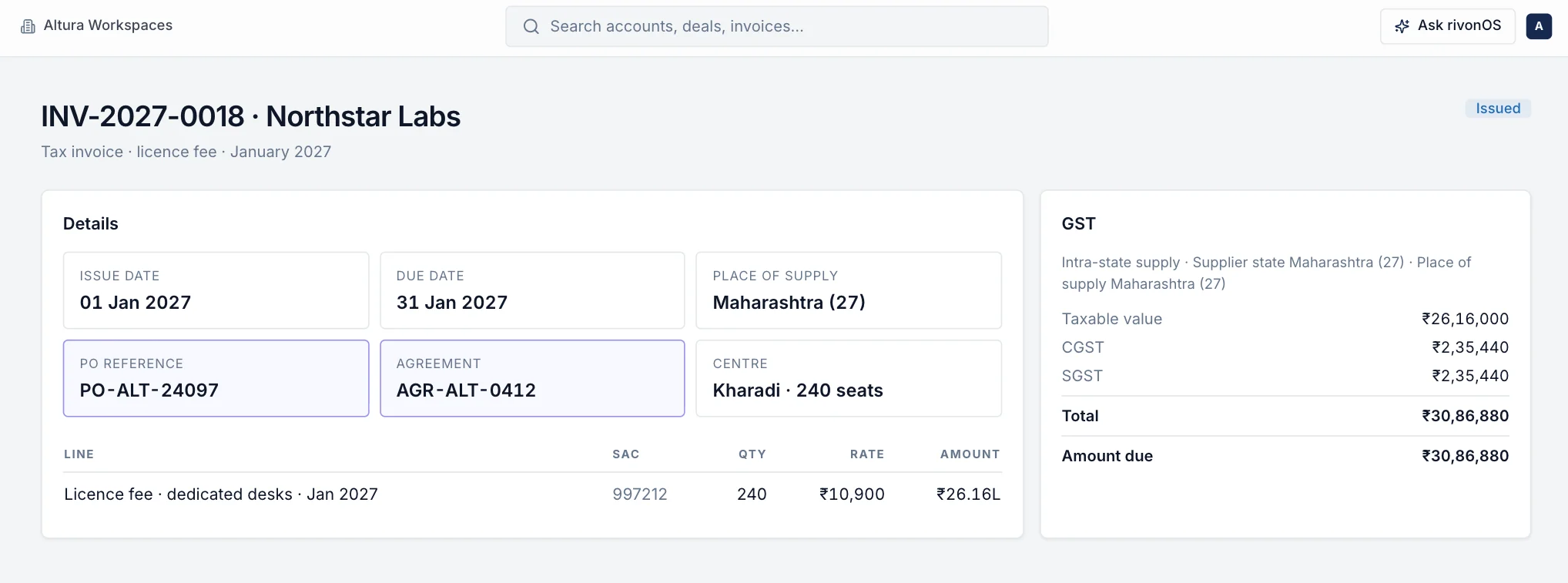
Northstar Labs licenses 240 seats at Altura Workspaces' Kharadi centre in Pune at ₹10,900 per seat a month, for 36 months from January 2027. Altura bills from its Maharashtra GSTIN. Northstar gives its Maharashtra GSTIN.
| Line | Amount |
|---|---|
| Workspace licence fee, 240 seats, January 2027 (SAC 997212) | ₹26,16,000 |
| CGST at 9% | ₹2,35,440 |
| SGST at 9% | ₹2,35,440 |
| Invoice total | ₹30,86,880 |
Place of supply: Maharashtra (27). Reverse charge: No. If Northstar deducts TDS, it deducts on ₹26,16,000 and not on the GST, because the GST is shown separately. The TDS guide explains the rates and sections.
Illustrative data: Altura Workspaces and Northstar Labs are fictional. Screens are faithful renderings of rivonOS.
How rivonOS handles GST today
See billing and collections for how invoices, notes and receipts work in the product.
Questions operators ask
Is GST charged on a coworking membership?
Yes, if the operator is registered. A coworking membership or managed office licence is a taxable supply, usually under SAC 997212 at 18%.
Should I charge IGST to a client in another state?
Usually not. The place of supply is where the centre is (IGST Act, section 12(3)), so if you bill from the GSTIN in the centre's state, you charge CGST and SGST whatever the client's home state.
Is GST payable on a security deposit?
Not when you receive a refundable deposit. GST applies when you apply the deposit to a charge that was not already invoiced, such as a lock-in charge.
Do I need a credit note when a client reduces seats?
Yes, if the period has already been invoiced. Raise a credit note under Rule 53 against the original invoice. Never edit an issued invoice.
Does rivonOS generate e-invoices?
Not yet. It issues Rule 46 tax invoices and Rule 53 notes as PDFs. IRN reporting is planned.
Sources
Primary sources, checked on 7 October 2026:
- CGST Rules, Rule 46 (tax invoice) and Rule 53 (revised invoice, credit and debit notes), CBIC tax information portal.
- IGST Act, 2017, section 12 (place of supply where supplier and recipient are in India), CBIC.
- CBIC Circular 178/10/2022-GST, 3 August 2022, on liquidated damages, compensation and penalties (para 7.1.6 on early termination of a lease).
- CBIC Notification 10/2023-Central Tax, 10 May 2023 (e-invoicing threshold of ₹5 crore from 1 August 2023), summarised by EY India.
- GSTN advisory on the time limit for reporting e-invoices for AATO of ₹10 crore and above, hosted by Maharashtra GST.
- CBIC Notification 78/2020-Central Tax, 15 October 2020 (number of HSN or SAC digits on invoices).
- CGST Act, 2017: section 2(30) and section 8 (composite supply), section 2(31) (consideration and deposits), section 15(3) (discounts), section 31 (tax invoice), section 34 (credit and debit notes), on the CBIC tax information portal.
- Notification 11/2017-Central Tax (Rate), as amended (rates for services under heading 9972), on the CBIC GST portal.
Changes to this guide: first draft, 7 October 2026.