For managed office operators
Managed office software for India
For operators who sell by the contract, not the desk.Managed office is an enterprise contract business: a 240-seat requirement, a 36-month term, a lock-in, an escalation, a deposit and a purchase order. rivonOS runs that contract from the first requirement to the renewal.

What makes managed office different
The listed operators' own filings describe the business: enterprise clients, long lock-ins, yearly escalation, brokers and purchase orders. That is a contract business, and it needs commercial software, not desk-booking software.
88.49%
of one listed Indian operator's rental revenue in FY25 came from enterprise clients. Clients with more than 300 seats brought 63.44%.
Source: A listed operator's IPO prospectus, July 2025
36–60 months
is how long another listed operator's client agreements typically run, with lock-ins of 24 to 48 months and about 6% escalation a year.
Source: A listed operator's IPO prospectus, July 2025
60.87%
of that operator's seats in FY25 were sold with a brokerage partner. Its services begin on receiving a letter of intent or purchase order.
Source: A listed operator's IPO prospectus, July 2025
76.06%
of a third listed operator's net membership fees came from enterprise members, with membership fees typically escalating 6% every year.
Source: A listed operator's draft IPO prospectus
73%
of a fourth listed operator's seats have a lock-in of 24 months or more. Weighted tenure is about 37 months, and 46% of clients use more than one centre.
Source: A listed operator's investor presentation, Q3 FY26
The managed office deal, stage by stage
Seven stages, one record. Each stage knows what was agreed in the one before it.
Stage 1
A requirement, not an enquiry
Seats, cabins, a move-in date, a tenure and often a fit-out brief. Brokers bring many of these deals. rivonOS keeps the requirement and every revision of it on record, with the broker as the source.
Stage 2
Availability across floors and centres
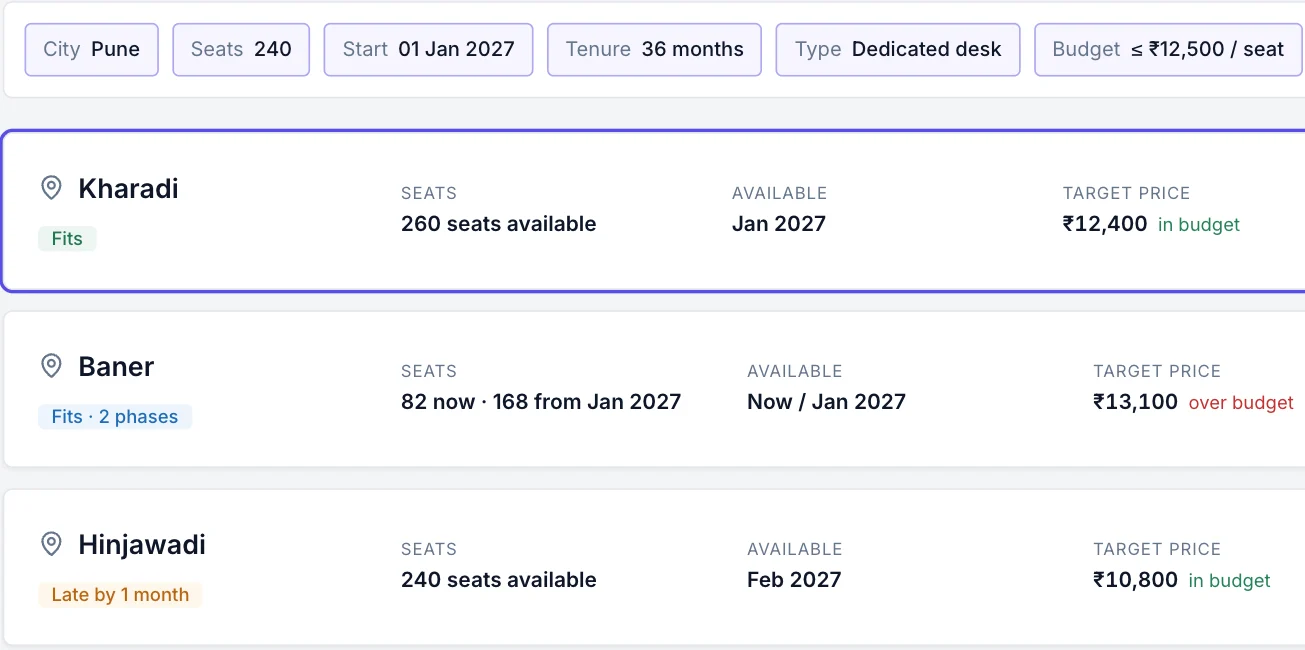
A 240-seat requirement rarely fits one floor today. rivonOS ranks what you can sell across centres, floors and sections, including seats that free up later, so you can offer a phased move-in.
Stage 3
Long-tenure pricing
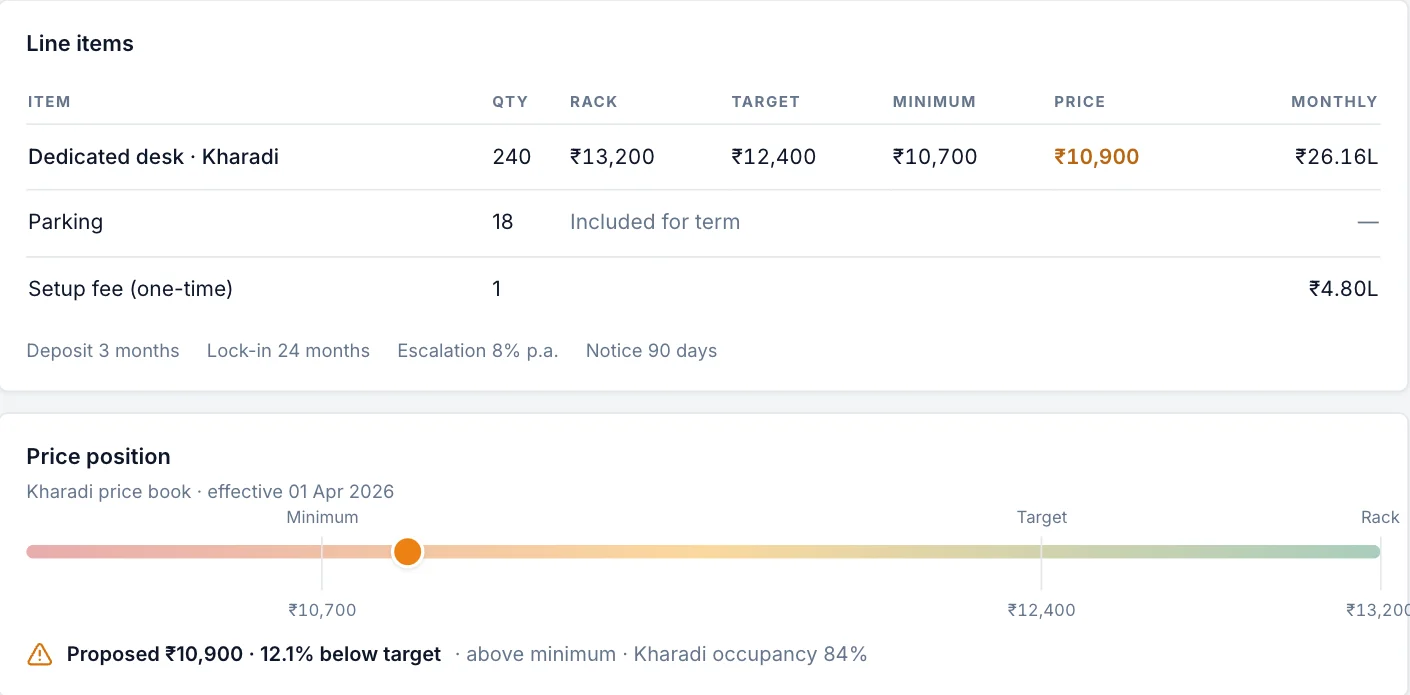
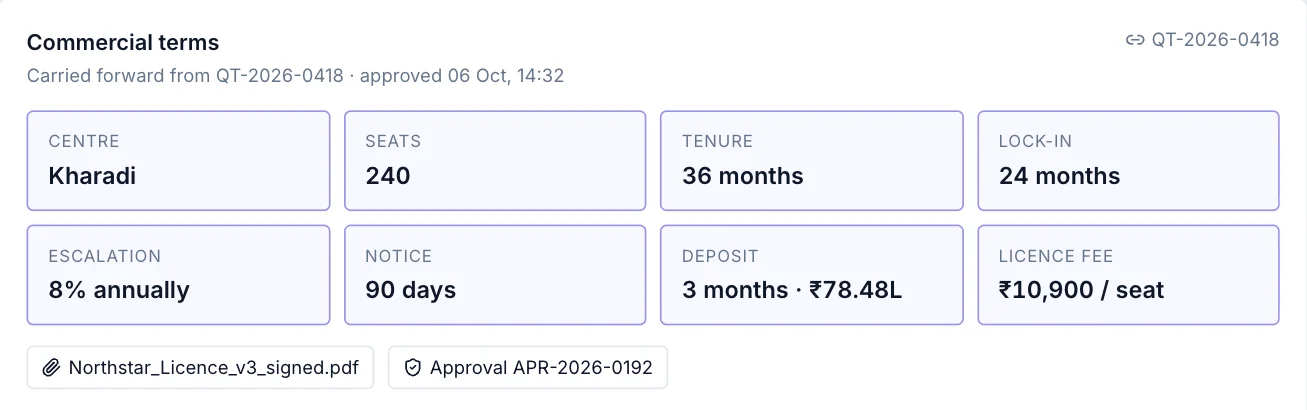
A 36-month contract with 8% escalation is worth more than its first-year rent suggests. Quotes work out the monthly charge, GST, deposit and contract value with escalation, exactly, every version kept.
Stage 4
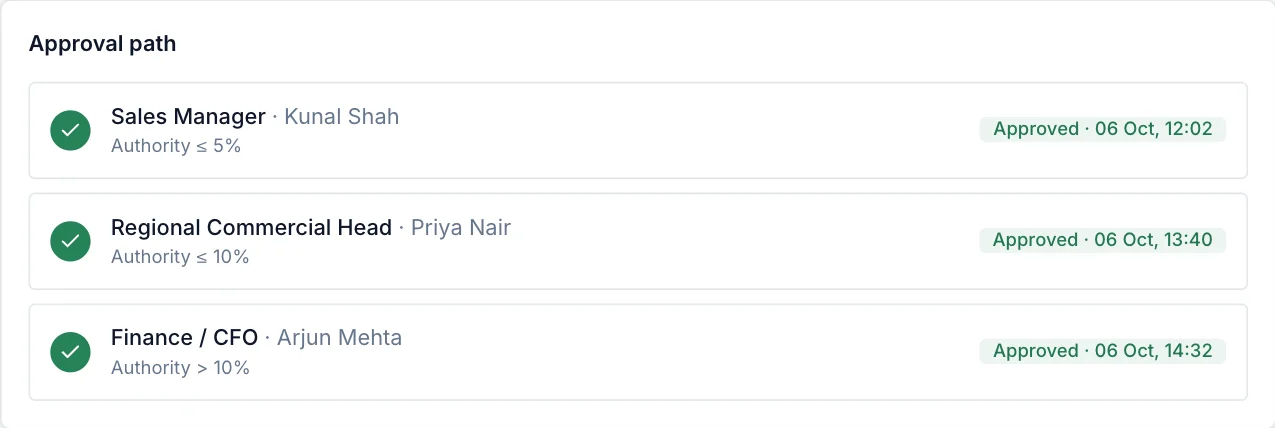
Approval before the price leaves the building
Discounts below target route to the right level. Nobody approves their own deal. Free months, deposit waivers and waived escalations are recorded with their cost over the full term.
Stage 5
An agreement that matches the approved quote
Lock-in, notice, escalation and deposit come from the approved quote. If the agreement drifts, it goes back for approval. Escalation dates and notice windows become dated obligations.
Stage 6
PO-led billing
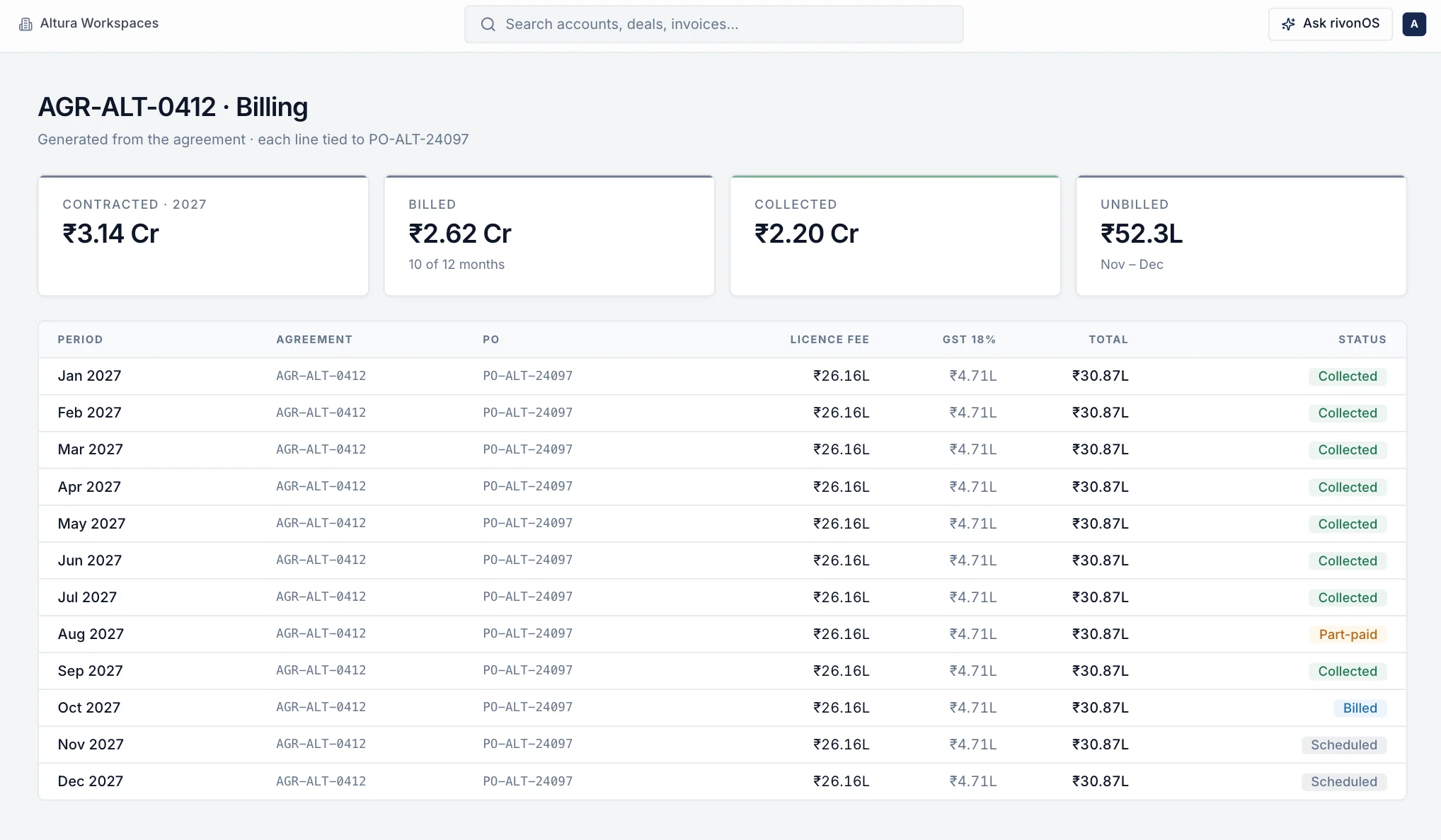
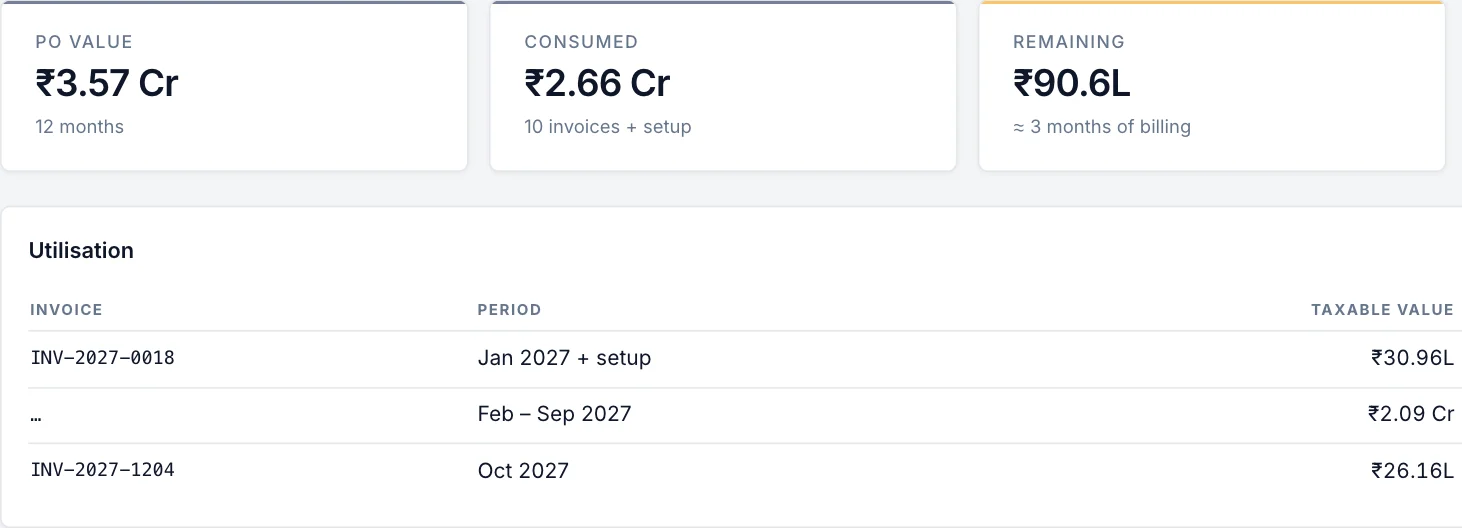
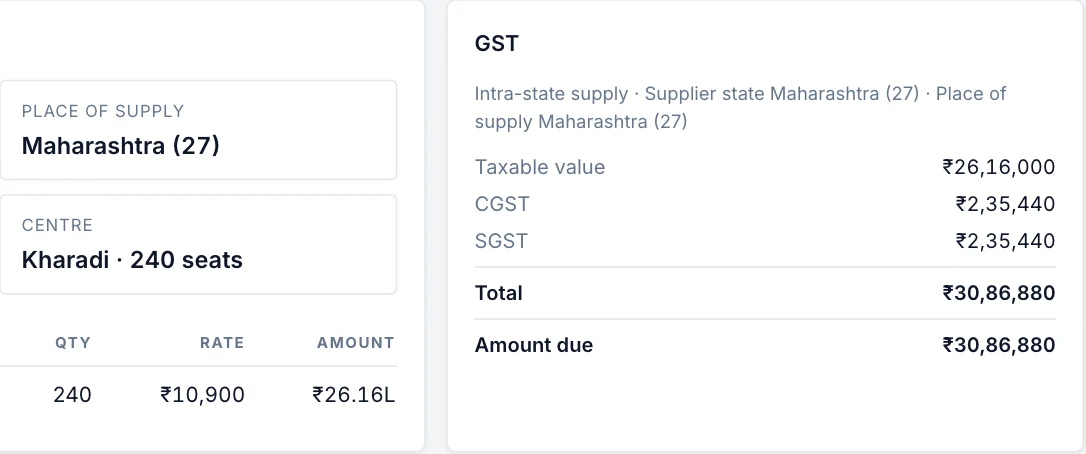
Enterprise clients pay against purchase orders. rivonOS checks the PO's validity and balance before every invoice and issues GST tax invoices under CGST Rule 46, with a second person approving each one.
Stage 7
Renewal and expansion
Renewals open 180 days before expiry with a rule-based risk score. When the same client needs more seats in another city, the new requirement starts with its full commercial history.
What it looks like in rivonOS
Northstar Labs needs 240 seats in Pune from January 2027, for 36 months. Here is that deal at four moments.
Illustrative data: Altura Workspaces and Northstar Labs are fictional. See how the platform fits together
Ready for enterprise procurement
Large clients buy through procurement and pay through accounts payable. Their teams reject invoices that do not match the PO, the GSTIN or the agreement. rivonOS checks these before the invoice goes out.
- Purchase orders
- Record the client's PO with its value and validity. Before every invoice, rivonOS checks that the PO is still valid and has enough balance left. If it does not, the invoice is held until finance resolves it, instead of reaching the client's accounts team against a PO that cannot pay it.
- GST from the right state
- Each centre bills from its own GSTIN and state. Place of supply decides CGST and SGST or IGST on every line, and the invoice carries GSTINs, state codes and SAC as CGST Rule 46 requires. A client in three cities gets three correct invoices, not one wrong one.
- TDS on receipts
- Enterprise clients pay net of TDS. Record the TDS with the payment and it settles the invoice like cash, instead of leaving a small balance open on every invoice for collections to chase.
Your own buying works the same way. Housekeeping, security and maintenance suppliers get purchase orders with GST worked out, and their bills are checked against the order and what arrived before anyone approves them. See vendors and procurement.
Read the GST guide and the TDS guide, or see the annotated GST invoice format.
From fit-out to move‑in, without a lost handover
Your project team builds the space. rivonOS makes sure the commercial and operational side is ready on the day the client moves in.
Step 1
On the requirement
The fit-out need is recorded on the requirement, with its commercial terms, such as a set-up fee, carried into the quote and the agreement.
Step 2
Into a move-in checklist
When the deal is signed, a readiness checklist starts for the client, covering items such as the agreement, deposit, KYC, PO, first invoice, IT set-up, internet, access cards, branding and parking.
Step 3
Readiness you can see
The move-in shows what is done and what is pending, and readiness updates as items are done, so the sales team, the centre team and finance see the same picture before move-in day.
Reporting across every centre
Enterprise clients often use more than one centre, and the business is reviewed as a portfolio. rivonOS reports by centre and for the whole portfolio from the same records.
- Every centre on one view
- The control tower shows occupancy, contracted revenue, dues, renewals coming up and revenue at risk for the portfolio and for each centre.
- One definition per number
- Occupancy, contracted revenue and dues are worked out the same way in every report, so two centres are compared like with like.
- The monthly MIS pack
- The numbers for the monthly review come from the same records the teams work in, not from spreadsheets copied together at month end.
- Forward occupancy
- How full each centre will be, week by week or month by month: seats contracted, moving in and ending, with renewals and weighted pipeline. A new client counts only once the deposit is in.
What rivonOS does not do
So you can plan your stack honestly.
- Fit-out and design-and-build project management
- rivonOS records a fit-out need on the requirement, but it does not plan or track the build. Keep your project tools.
- Access control and Wi-Fi
- rivonOS is not a building system. Visitor registration tells reception who to expect, but doors, badges and Wi-Fi stay with your building systems. Your clients' employees do get the member experience: bookings, guests, requests and benefits.
- Your accounting books
- rivonOS issues GST invoices and records receipts. Your general ledger stays in your accounting system. There is no Tally or Zoho Books integration yet.
- GST e-invoicing
- IRN and e-invoice QR codes are in development and coming soon. Today rivonOS issues Rule 46 tax invoices as PDFs.
Questions operators ask
Is rivonOS coworking software?
Can it handle cabins and open seats in one deal?
How does it deal with escalation over a long lock-in?
We bill against client POs. What happens when a PO runs out?
Our client takes seats in two states. How is GST handled?
Clients pay us net of TDS. Does that leave invoices part-paid?
Can we see all our centres in one place?
Can we see how full our centres will be when large agreements end?
Can we run our own vendors and purchase orders in rivonOS?
Does rivonOS generate e-invoices with an IRN?
Do you manage the fit-out?
Guides and tools

See how rivonOS would work across your centres.
One hour with the people who built it, using your own centres. If rivonOS isn't the right fit, we'll tell you.