Coworking break-even occupancy: formula and example

The short answer
Break-even occupancy is the share of your sellable seats that must be occupied and paying for a centre to cover its fixed monthly costs. Work it out in three steps: contribution per occupied seat = realised revenue per seat − variable cost per seat; break-even seats = fixed monthly costs ÷ contribution per seat; break-even occupancy = break-even seats ÷ sellable seats. In the illustrative example below, a 200-seat centre with ₹12 lakh of fixed costs and ₹7,500 contribution per seat breaks even at 160 seats, or 80% occupancy. The break-even calculator linked below does this for your own numbers.
Who this guide is for
This guide is for founders, finance heads and centre heads who want to know how full a coworking or managed office centre must be before it covers its costs: when planning a new centre, setting prices, or reviewing a centre that is not performing.
It explains a management calculation, not an accounting statement. Use your own audited numbers for financial reporting and tax.
What break-even occupancy means
A centre has two kinds of cost:
- Fixed costs stay roughly the same whether the centre is half empty or full: rent or the revenue share with the landlord, common-area power, the centre team's salaries, internet, housekeeping and security contracts, maintenance, and software.
- Variable costs rise with each occupied seat: consumables, tea and coffee, power used at the desk, cleaning supplies, and payment charges.
Each occupied seat brings in revenue and adds a little variable cost. What is left over, the contribution, goes towards the fixed costs. Break-even is the point where the contribution from occupied seats exactly covers the fixed costs.
The formula
- Contribution per occupied seat = realised monthly revenue per occupied seat − variable monthly cost per occupied seat
- Break-even occupied seats = total fixed monthly costs ÷ contribution per occupied seat
- Break-even occupancy = break-even occupied seats ÷ total sellable seats
Use realised revenue: what clients actually pay per seat after discounts, rent-free months and other concessions, not your list price. Keep all amounts before GST.
If the contribution per seat is zero or negative, the centre can never break even by filling seats. Each new seat loses money, and the fix is price or variable cost, not occupancy. If break-even seats come out higher than your sellable seats, the centre cannot break even even when completely full.
Worked example
This example is illustrative. The numbers are chosen to show the method, not to describe a typical Indian centre.
A centre has 200 sellable seats. Clients pay a realised ₹9,000 per seat a month, and each occupied seat adds ₹1,500 of variable cost.
| Fixed monthly cost | Amount |
|---|---|
| Rent | ₹6,00,000 |
| Common-area power and utilities | ₹1,50,000 |
| Centre team salaries | ₹2,50,000 |
| Internet and software | ₹60,000 |
| Housekeeping, security and maintenance contracts | ₹1,00,000 |
| Other fixed costs | ₹40,000 |
| Total fixed costs | ₹12,00,000 |
- Contribution per occupied seat = ₹9,000 − ₹1,500 = ₹7,500
- Break-even occupied seats = ₹12,00,000 ÷ ₹7,500 = 160 seats
- Break-even occupancy = 160 ÷ 200 = 80%
At 85% occupancy (170 seats):
- Revenue = 170 × ₹9,000 = ₹15,30,000
- Variable costs = 170 × ₹1,500 = ₹2,55,000
- Contribution = 170 × ₹7,500 = ₹12,75,000
- Operating contribution after fixed costs = ₹12,75,000 − ₹12,00,000 = ₹75,000 a month
At 75% occupancy (150 seats), the same centre falls short by 150 × ₹7,500 − ₹12,00,000 = −₹75,000 a month.
What moves break-even
Small changes to price and cost move break-even more than most operators expect. Starting from the example above:
| Change | Contribution per seat | Break-even seats | Break-even occupancy |
|---|---|---|---|
| None (the example) | ₹7,500 | 160 | 80.0% |
| Realised price ₹500 lower | ₹7,000 | 171.4 | 85.7% |
| Rent ₹50,000 a month higher | ₹7,500 | 166.7 | 83.3% |
| Variable cost ₹500 higher per seat | ₹7,000 | 171.4 | 85.7% |
A ₹500 discount on every seat, about 5.6% of the price, raises break-even by nearly six percentage points. This is why unapproved discounts and concessions matter: see where flex revenue leaks.
Contribution is not profit
Operating contribution after fixed costs is not the centre's profit. It leaves out:
- Depreciation on fit-out and furniture, and interest on any loan that paid for them.
- Your share of head-office costs: leadership, sales, finance and marketing.
- One-time costs such as broker fees, launch costs and fit-out repairs.
- Income tax.
A centre that just covers its fixed costs is not yet paying back the money spent to build it. Many operators set a target occupancy above break-even that also recovers fit-out over a set number of years.
Mistakes to avoid
- Using list price instead of realised price. Discounts, rent-free months and free parking all lower the real revenue per seat.
- Mixing contracted and physical occupancy. Contracted occupancy counts seats under agreement; physical occupancy counts people who turn up. Break-even depends on paying seats, so use contracted seats that are being billed.
- Counting seats that cannot be sold. Use sellable seats, not the total desks on the floor plan.
- Treating power as all fixed or all variable. Split it: common areas are fixed, desk use is variable.
- Ignoring the ramp-up. A new centre spends months below break-even while it fills. Plan the cash for it.
- Forgetting escalations. Rent often escalates on a schedule. Check break-even again each time it does.
Use it every month
Work out break-even for every centre once a month, using actual fixed costs and realised revenue for that month, and put it next to contracted occupancy. A centre whose break-even is rising while occupancy is flat needs attention before the gap shows up in cash.
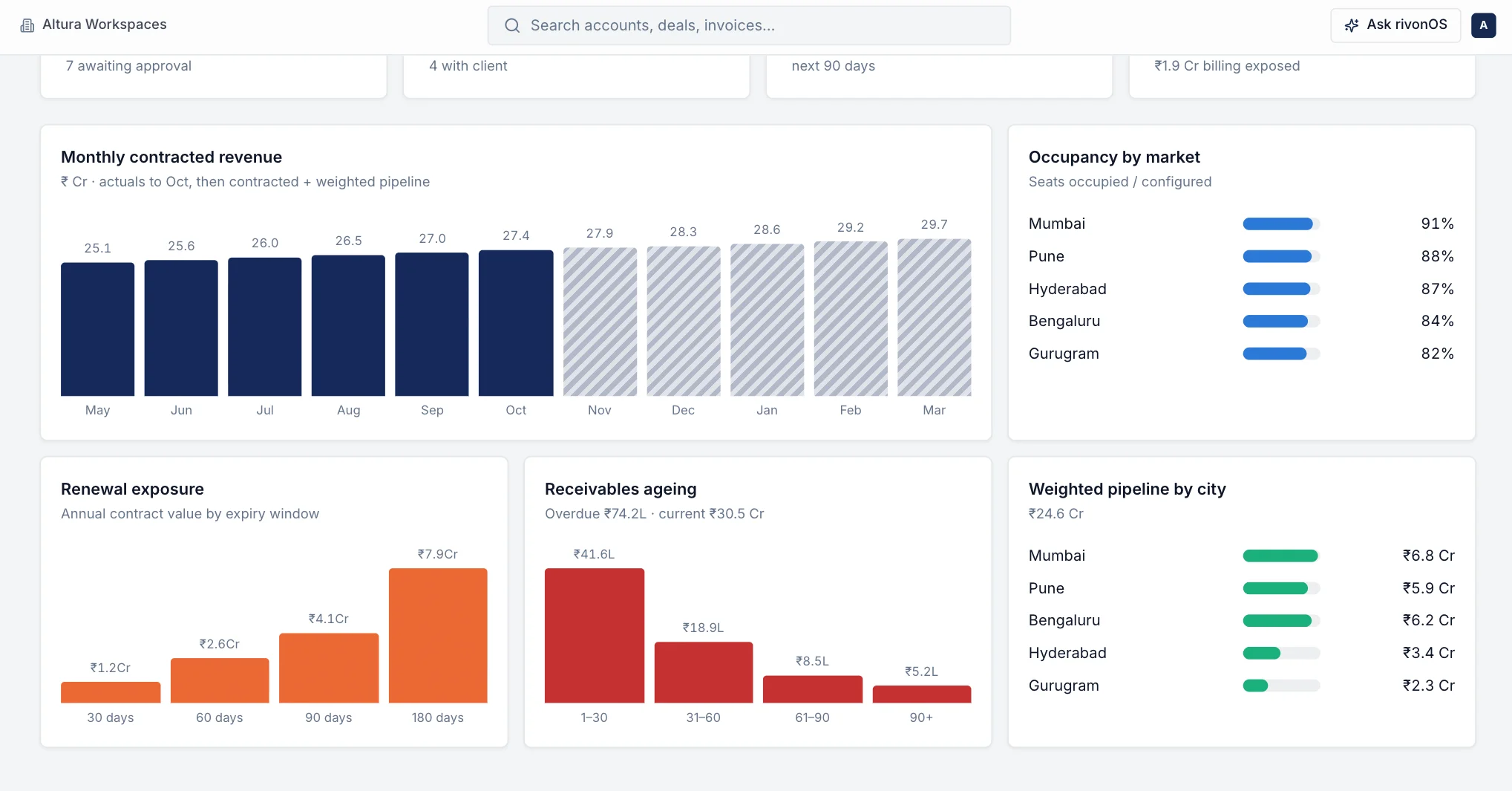
In rivonOS, the control tower shows occupancy, contracted revenue and collections by centre, so the revenue side of this calculation comes from your agreements and invoices rather than a separate sheet. To see it on your own centres, book a walkthrough.
Questions operators ask
What is a good break-even occupancy for a coworking space?
There is no single right number. It depends on rent, realised price and how the centre is run. A lower break-even gives the centre more room to absorb a client leaving. Work it out for each of your centres and track how it moves.
Should break-even be based on desks or on revenue?
The formula here uses seats, because most coworking revenue is priced per seat. If you sell cabins or whole floors, convert them to seats at the same realised price, or work out break-even in revenue: fixed costs ÷ (1 − variable costs as a share of revenue).
Does break-even include GST?
No. Keep revenue and costs before GST. GST collected from clients is not your revenue.
How do meeting room and other add-on revenues fit in?
Add regular add-on revenue to the realised revenue per occupied seat, or subtract it from fixed costs. Leave out one-off income that you cannot count on every month.
Related reading: how to manage multiple coworking centres and the seat price calculator.