How to improve coworking member retention

The short answer
Retention in a coworking centre has two parts: individual members who stop coming, and client companies that don't renew their agreement. Track both every month. Most departures show warning signs months earlier: requests left unresolved, rooms and benefits unused, invoices paid late, headcount shrinking, and an account owner who has gone quiet. Act on those signs with a 30, 60 and 90-day plan, fix service failures quickly and visibly, and open every renewal conversation at least 90 days before the agreement ends.
Who this guide is for
This guide is for founders, centre managers and community managers at coworking and managed office centres in India who want fewer members leaving and more agreements renewed. It works with or without software.
Members leave, and companies don't renew
A coworking centre loses revenue in two different ways, and they need different responses.
- Member churn. Individual people stop using the space. A freelancer cancels a dedicated desk, or employees of a client company stop coming in. Each departure is small, but a steady trickle empties a floor.
- Contract renewal. A client company decides whether to renew its agreement when it ends. One decision can move 50 or 200 seats at once.
They are linked but not the same. A company can keep paying for 40 seats while half its people have stopped coming: member engagement is falling, but the renewal problem hasn't arrived yet. Track both, so you see the first before it becomes the second.
How to measure retention and churn
Measure monthly and quarterly, by centre.
Member churn = members who left in the period ÷ members at the start of the period
Member retention = (members at the end − new members who joined in the period) ÷ members at the start
Renewal rate (by agreement) = agreements renewed ÷ agreements that came up for renewal in the period
Renewal rate (by seats) = seats renewed ÷ seats that came up for renewal
Illustrative example. A centre starts the quarter with 400 members. During the quarter 60 members leave and 90 new members join, so it ends with 430.
- Member churn = 60 ÷ 400 = 15%
- Member retention = (430 − 90) ÷ 400 = 340 ÷ 400 = 85%
In the same quarter, 20 agreements covering 600 seats come up for renewal. 16 agreements renew, covering 450 seats.
- Renewal rate by agreement = 16 ÷ 20 = 80%
- Renewal rate by seats = 450 ÷ 600 = 75%
The seat rate is lower because the four companies that left were larger than average. Report the seat rate to leadership: it is closer to revenue.
Early warning signs
Watch for these, centre by centre and client by client:
- Requests left unresolved, or closed with a low rating. A member who reported the AC three times will not recommend you.
- Low use of rooms and benefits. Meeting-room hours, guest passes and events that go unused suggest people are not getting value from the membership.
- Fewer people coming in from a client company, or fewer active members on its account.
- Invoices paid later than before, or partial payments where there were none. This often comes before a decision to cut seats.
- Headcount shrinking at the client: leavers removed, no joiners added.
- No contact from the account owner for several months, or a new admin who doesn't know you.
One sign is a reason to ask. Two or more together are a reason to act this week.
A 30, 60 and 90-day plan
First 30 days for a new client
- Check in with the company admin in the second week: is everything as promised?
- Confirm every member has access to the member app and has booked a room or invited a guest at least once.
- Close any move-in requests still open.
Day 60
- Review requests and their ratings for the client. Fix anything repeated.
- Invite the team to one event or benefit that fits their work.
- Confirm the first two invoices were correct and paid without queries.
Day 90 and every quarter after
- A short review with the account owner: what's working, what isn't, any change in headcount plans.
- Look at use of rooms and benefits against what the agreement includes.
- Note anything that could affect renewal, with a named owner.
Community engagement that fits Indian centres
Engagement works when it saves members time or helps their business, not when it fills a calendar.
- Founder or HR breakfasts once a month, where companies in the centre meet each other.
- Practical sessions run with a CA or lawyer: GST basics for small companies, payroll compliance, or hiring.
- Festival celebrations planned with members, such as Diwali, Onam or Pongal depending on the city and the members, kept short and inclusive.
- Wellness slots members can book, such as yoga before work, if they are used.
- Introductions: a member looking for a designer or an accountant hears about one in the building first.
- Clear notices for things that affect the day: power maintenance, water supply, fire drills and traffic diversions.
Ask members what they want, track who attends, and drop what nobody comes to.
Service recovery
How you handle a failure matters more than the failure. When something goes wrong:
- Acknowledge it the same day, with a named person.
- Give a realistic time to fix it, and keep members updated if it moves.
- Fix the cause, not only the symptom, and tell the member what changed.
- For repeated problems, the centre lead calls the company admin, not just the member who complained.
Renewals start 90 days ahead
Most agreements have a notice period. If the first renewal conversation happens inside it, you are negotiating against a deadline.
- List every agreement ending in the next 6 months, with its notice date.
- Open the conversation at least 90 days before the end date, earlier for large clients.
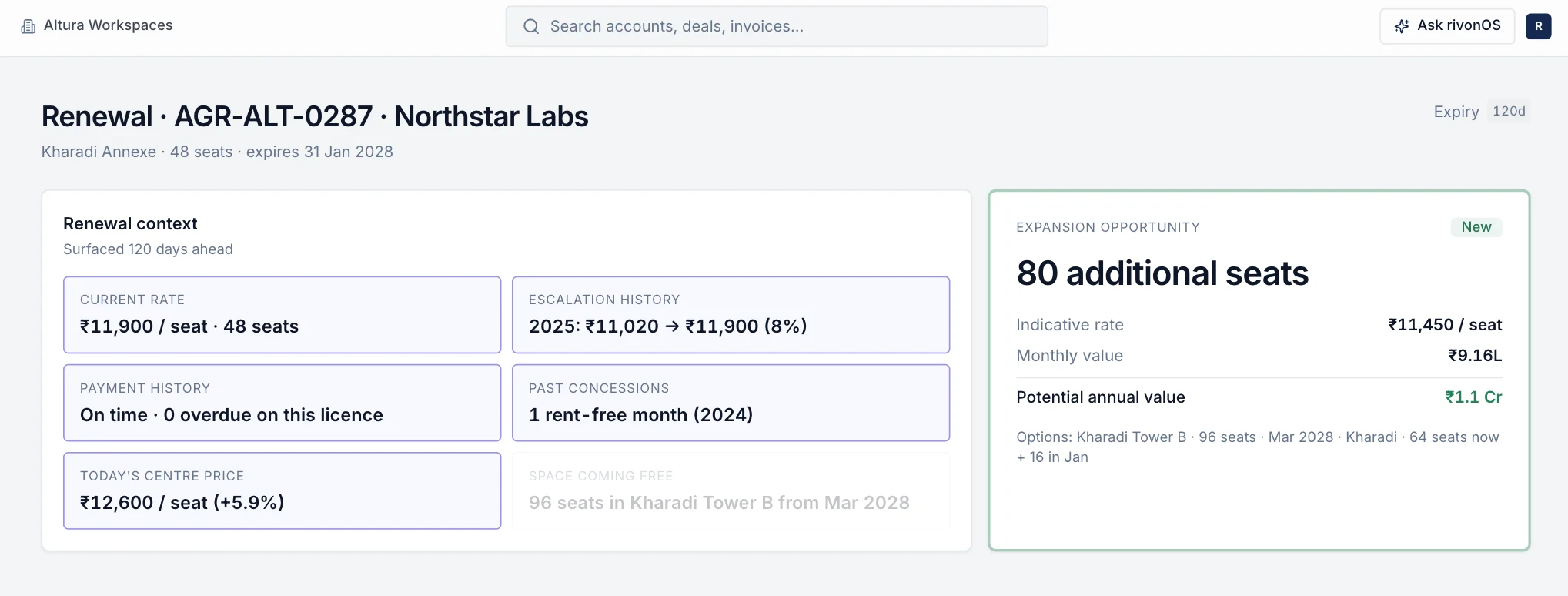
- Bring the facts: seats used, requests and ratings, invoices and any disputes, and planned escalation.
- Ask about growth before price. An expansion is easier to agree than a renewal at a discount.
Mistakes to avoid
- Measuring only total occupancy, which hides members leaving and new ones joining.
- Leaving renewals to the last month, when the client has already seen other centres.
- Treating complaints as front-desk issues when the same problem keeps recurring.
- Running events nobody asked for, and counting attendance instead of value.
- Not knowing who the account owner is after a change at the client.
Retention in rivonOS
See member experience, community operations and agreements and renewals. To see how this would work for your centre, book a walkthrough for your centre.
Questions operators ask
What is the difference between member churn and renewal rate?
Member churn counts individual people who leave. Renewal rate counts client agreements, or seats, renewed when they end. A centre can have low member churn and still lose a large client at renewal, so track both.
How often should we measure retention?
Monthly by centre, with a quarterly review across centres. Renewal rates are more useful by quarter, because only a few agreements end each month.
What is the fastest way to reduce churn?
Fix unresolved and repeated requests, and start renewal conversations 90 days ahead. Both cost little and act on clients you already have.
Related guides: the member onboarding checklist and the community manager daily checklist.