Draft for expert review. This page is not published to search engines until a practising advocate has checked it. Do not rely on it for tax or legal decisions.
Coworking agreement checklist: clauses to include

The short answer
A coworking or managed office agreement in India is usually a licence (often called a leave and licence), not a lease: the client gets the right to use seats and services, not possession of the premises. It should name the parties, the centre and the seats, and set out the term, lock-in, notice period, licence fee, escalation, security deposit and its refund, GST, TDS and purchase order terms, payment terms and late fees, the services included, rules of use, confidentiality, liability, termination and exit. This checklist helps you see what is missing. It is not legal advice: have a lawyer draft or review your template, and check stamp duty and registration rules for your state.
Who this checklist is for
Founders, centre heads, sales and finance teams at coworking and managed office operators in India who sign agreements with client companies. Use it when you write your standard agreement, when a large client sends its own draft, and when you review an agreement before renewal.
A licence, not a lease
Most coworking and managed office agreements are licences, often called leave and licence agreements: the client gets permission to use seats and services in your centre, while you keep possession and control of the premises. That is different from a lease, which transfers an interest in the property. The difference matters for termination, stamp duty and how disputes are handled, so the agreement should say clearly what it is, and what you actually do should match it: you control access, keep the keys and provide the services.
If you sublicense space from a landlord, check that your own lease allows it, and that nothing in your client agreements promises more than your lease gives you.
Parties and premises
- Parties: your legal entity name, the client's legal entity name, registered addresses and GSTINs, and who signs for each.
- Centre and location: the centre address and floor, and whether you can move the client to equivalent seats in the same centre.
- Seats and products: number of seats, type (hot desk, dedicated desk, private cabin, managed floor), and the seat or cabin numbers or a floor plan as an annexure.
- Start date and move-in conditions: what must be ready on day one, and what happens if the space isn't ready.
- Capacity: how many people may use each seat, and rules for headcount above the contracted seats.
Term, lock-in and notice
- Term: start and end dates, and whether the agreement renews automatically.
- Lock-in: the minimum period during which the client can't exit without paying, and what they pay if they leave early (often the fee for the rest of the lock-in).
- Notice period: how much notice either side must give to end the agreement after the lock-in, how notice is given, and to whom.
- Renewal: whether renewal is automatic or by a new agreement, and how the price is set on renewal.
- Expansion and contraction: how the client adds or gives up seats mid-term, from what date, and at what rate. Changes should be made by a written amendment.
Fees, escalation and payment
- Licence fee: per seat or per cabin, per month, and the total monthly fee. State whether GST is extra (it usually is).
- Escalation: the percentage increase and the date it applies, for example a fixed percentage every 12 months from the start date.
- Part months: how the first and last months are charged.
- Payment terms: the invoice date, the due date and accepted payment methods.
- Late payment: any interest or late fee, and your right to suspend services after a stated period and notice.
- Add-ons: meeting room credits and charges beyond them, parking, printing, events, IT services and any other chargeable services, with rates in an annexure.
Security deposit
- Amount: usually a number of months of the licence fee.
- Interest: whether it is interest-free.
- Refund: when it is refunded after exit, and the conditions.
- Deductions: what can be deducted (unpaid fees, damage beyond normal wear and tear, unreturned access cards) and that deductions will be itemised with evidence.
- Adjustment: whether the client may adjust the deposit against the last months' fees (most operators don't allow it).
GST, TDS and purchase orders
- GST: that GST is charged at the applicable rate on the licence fee and services, with each party's GSTIN. See the GST guide.
- TDS: how tax deducted at source is handled, and that the client will issue TDS certificates on time so you can match them with Form 26AS. See the TDS guide.
- Purchase orders: if the client works on POs, that invoices will quote the PO number, and what happens when a PO expires or runs out mid-term.
Services, access and conduct
- Services included: internet, power, housekeeping, reception, meeting room credits, pantry, and service hours.
- Service levels: how requests are raised and how quickly they are handled. Promise only what you can deliver.
- Access: hours, access cards, visitors, and any areas that are off-limits.
- House rules: conduct, noise, deliveries, use of common areas, as an annexure that you can update with notice.
- Alterations: no changes, branding or IT equipment installed without written approval.
Data, confidentiality and liability
- Confidentiality: both sides keep each other's confidential information private.
- Personal data: how you handle member and visitor data, under India's data protection law. Keep it consistent with your privacy notice.
- Insurance: what you insure (the premises) and what the client should insure (its own equipment and people).
- Liability and indemnity: limits on each side's liability, and indemnities for damage or loss caused by one side's people.
- Force majeure: what happens if the centre can't be used for reasons outside your control.
Ending the agreement
- Termination: each side's right to end the agreement, for breach (with a cure period) and after the lock-in with notice.
- Exit and handover: the last day, return of access cards and parking stickers, removal of the client's belongings, and the condition the space must be left in.
- Final invoice and deposit: the final invoice, credit notes for anything billed in advance, and the deposit refund timeline.
- Survival: which clauses continue after the agreement ends, such as confidentiality and payment of dues.
- Disputes: governing law, the courts with jurisdiction, and whether disputes go to arbitration first.
Stamp duty and signing
Stamp duty and registration rules for licence agreements differ from state to state, and can depend on the term and the fees. Check the stamp duty and any registration requirement for your state with your lawyer before you sign, and keep a copy of the stamped, signed agreement for every client.
Sign agreements with the people who have authority to sign for each company, and keep amendments in writing.
Agreements in rivonOS
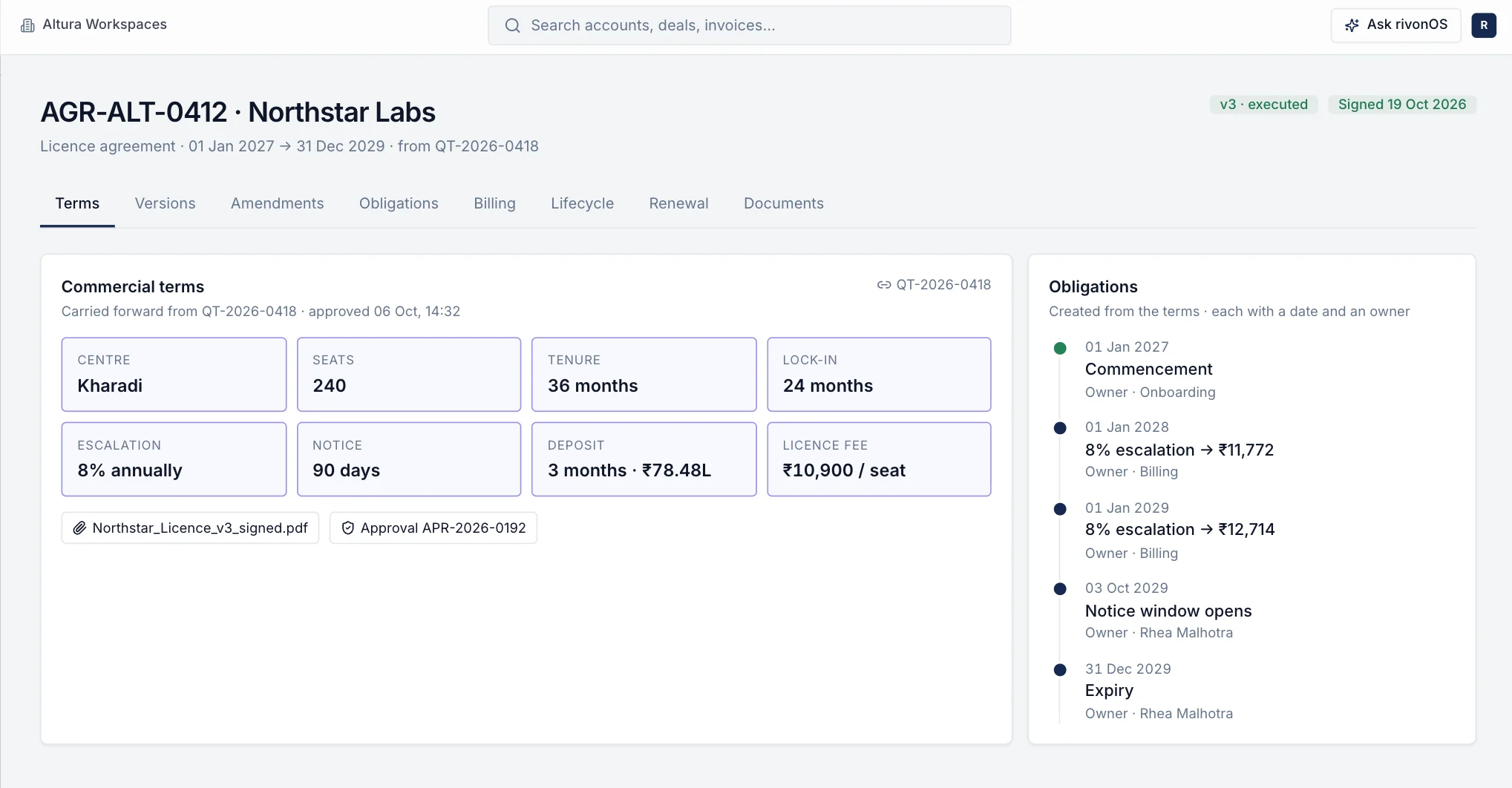
In rivonOS, an agreement is created from the approved quote, so the seats, price, escalation, lock-in and notice period can't drift from what was approved. Every term becomes something rivonOS tracks: the escalation date, the end of the lock-in, the last day to give notice and the deposit refund. Amendments update billing from the right date, and renewals open months ahead. rivonOS produces agreements from your own template; it doesn't give legal advice. See agreements and renewals.
Questions operators ask
Is a coworking agreement a lease or a licence? Usually a licence, often called a leave and licence. The client is allowed to use seats and services while you keep possession and control of the premises. Have a lawyer confirm your agreement is worded and operated that way.
Do I need to register a coworking agreement? It depends on your state, the term and the amount. Check the stamp duty and registration rules for your state with your lawyer.
Can a client exit during the lock-in? Only on the terms in the agreement. Most agreements let the client leave by paying the fee for the rest of the lock-in.
Which clauses cause the most disputes? In practice: deposit deductions, escalation dates, notice periods and charges for add-ons. Write them precisely and keep records.