Managed office vs coworking vs virtual office

The short answer
Coworking sells shared and private seats on flexible terms to individuals and teams. A managed office gives one company a dedicated, often customised space that the operator runs for them, usually on a longer agreement. A virtual office sells an address and services, not a desk. Many Indian operators offer all three: coworking fills seats, managed offices bring large, stable contracts, and virtual offices bring small clients who may grow. Each changes how you sell, set up, bill and service the client.
The short version
- Coworking: seats and cabins in a shared centre, on flexible terms, for freelancers, startups and teams.
- Managed office: a dedicated space for one company, often designed to its requirements, run by the operator, on a longer agreement.
- Virtual office: a business address and services such as mail handling and meeting-room access, without a desk.
Coworking
What it is. Members use shared desks, dedicated desks or private cabins in a centre with shared meeting rooms, pantry and reception.
Who buys it. Freelancers, founders, small and medium teams, and enterprise teams that need flexibility or a satellite office.
Typical terms. Monthly or short agreements, often with a lock-in period, a security deposit, and seat counts that can change. Meeting rooms and extras are often included as allowances or billed by use.
What matters most. Occupancy across many small agreements, a good member experience, and keeping members from leaving.
Managed office
What it is. A space dedicated to one company, inside a building the operator runs. The operator often fits it out to the client's layout and brand, then manages facilities, services and day-to-day operations.
Who buys it. Companies that want their own office without leasing, fitting out and running a building themselves, often teams of 50 seats and more.
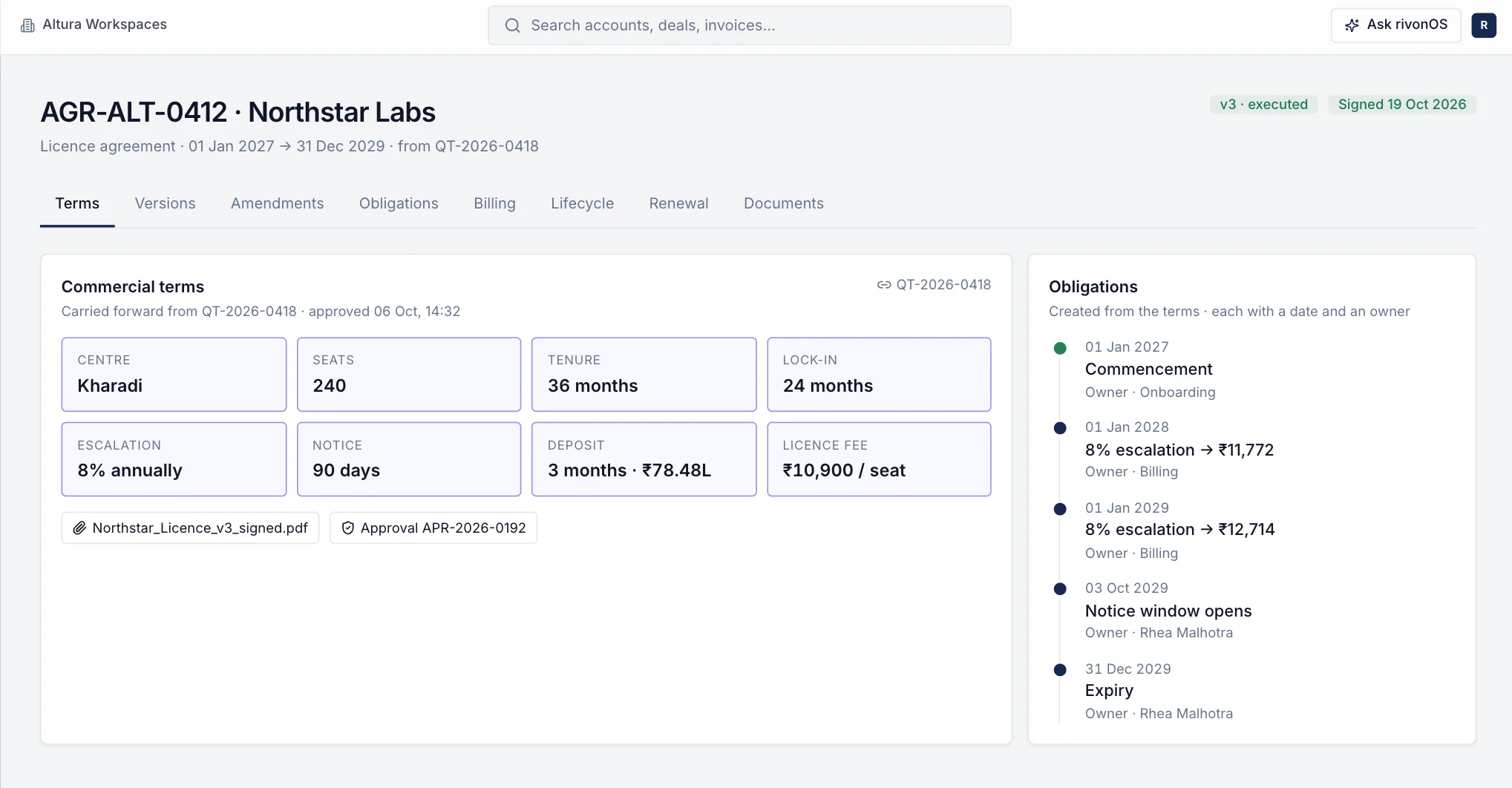
Typical terms. Longer agreements, often several years, with lock-in, annual escalation, larger security deposits, and fit-out costs recovered over the term. Enterprise clients often issue purchase orders and expect invoices that match them.
What matters most. Winning and keeping a few large contracts, delivering on service commitments, and billing that matches the agreement and the client's PO every month.
Virtual office
What it is. A business address at the centre, with services such as mail and courier handling, call answering or meeting-room hours on request.
Who buys it. New companies and businesses entering a new city or state, often for an address to register the business, and small firms that want a professional address.
Typical terms. Monthly or annual plans with a fixed fee, plus charges for meeting rooms or day passes used.
What matters most. Clean documentation, reliable mail handling, and a path to upgrade clients to desks as they grow.
Side by side
| Coworking | Managed office | Virtual office | |
|---|---|---|---|
| Space | Shared or private seats in a shared centre | Dedicated space for one company | No desk; address and services |
| Typical client | Individuals and teams | Mid-size and enterprise companies | New and small companies |
| Agreement length | Short or monthly, often with lock-in | Longer, often multi-year | Monthly or annual |
| Customisation | Low | High (layout, branding, IT) | None |
| Billing | Many small invoices, extras by use | Fewer, larger invoices, often against a PO | Fixed plan fees, extras by use |
| Operations focus | Member experience, community, bookings | Service levels, facilities, account management | Mail, documentation, front desk |
| Revenue profile | Many clients, more churn | Few clients, larger and steadier | Small, recurring |
What changes for your operations
- Sales. Coworking sales are fast and local. Managed office deals involve requirements, site visits, design, proposals, approvals and procurement, and can take months.
- Pricing and approvals. Managed office deals carry larger discounts, fit-out recovery and escalation terms, so approval rules matter more.
- Onboarding. A coworking move-in takes days; a managed office handover involves fit-out, IT and access for a whole company.
- Service. Coworking members raise many small requests; managed office clients expect agreed service levels and regular reviews.
- Renewals. Losing one managed office client can move a large share of a centre's revenue, so renewals need attention well before the notice period.
Billing and GST
All three are billed as services with GST tax invoices. What differs is the structure: coworking means many invoices with allowances and usage, managed offices mean recurring invoices tied to agreements, escalations and purchase orders, and virtual offices mean fixed plan fees.
For how GST applies to workspace fees, place of supply for clients in other states, and what each invoice must include, see our guide to GST on coworking and managed offices and the GST invoice format.
Which to offer
- Coworking only suits a single centre building a community and filling seats quickly.
- Adding managed offices suits operators with larger floors and the ability to fit out and run spaces for enterprises. It brings longer, larger agreements.
- Adding virtual offices uses spare reception capacity and brings small clients who may need desks later.
Many operators mix all three in one centre: a floor of managed offices, a coworking floor, and virtual office clients served from the same reception.
Running all three on one platform
See rivonOS for managed office operators. To see your mix of products in rivonOS, book a walkthrough.
Questions operators ask
Is a managed office the same as a serviced office?
The terms overlap. A serviced office usually means a ready, furnished private office with services, often in a shared building. A managed office usually means a space dedicated to one company, often customised, with the operator running it.
Which earns more, coworking or managed offices?
It depends on the centre, the market and costs. Managed offices bring larger, longer agreements; coworking can earn more per seat but with more turnover. Model both with your own numbers using the break-even calculator.
Can a virtual office client use the space?
Only as their plan allows, such as meeting-room hours or day passes. Make the plan clear in the agreement.